
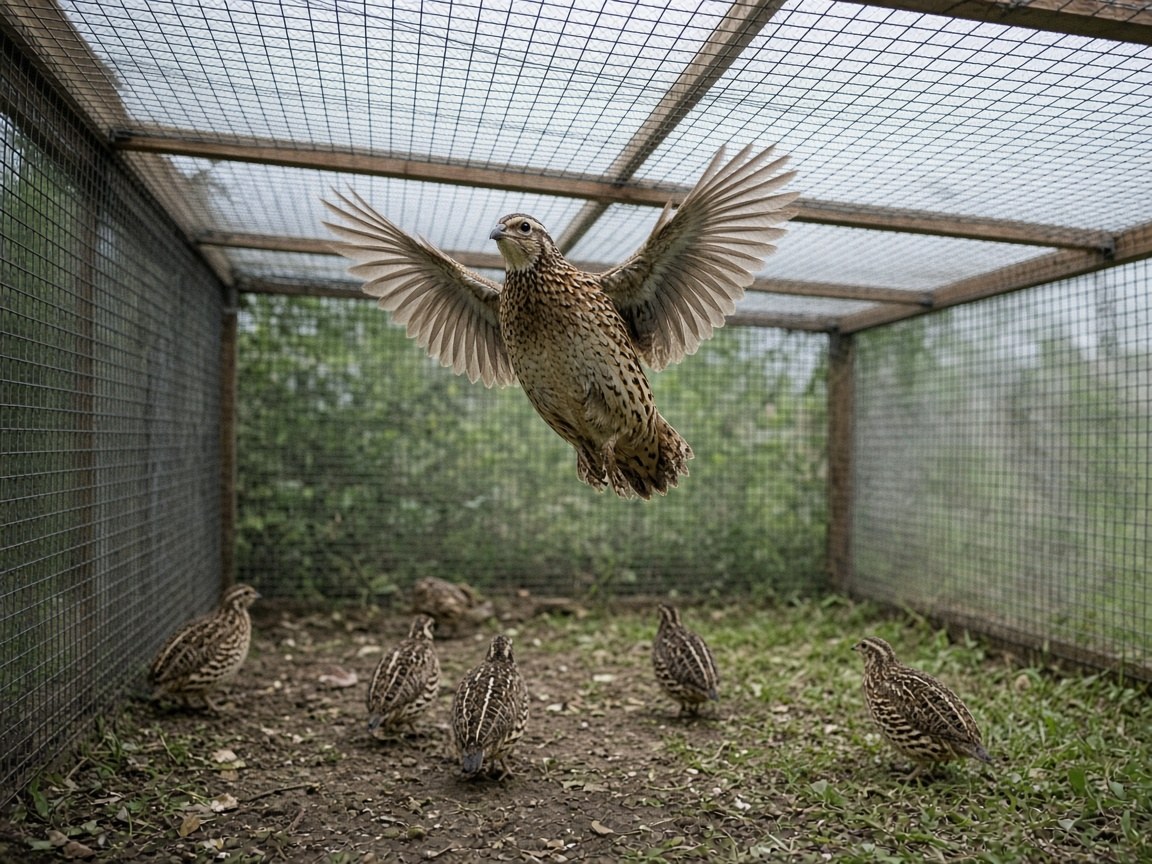
Quick answer: Yes. Backyard coturnix cannot migrate like a wild duck, but they flush straight up in a short, fast burst when they are startled, and they can clear an open fence in one jump-flight. That is why every pen needs a roof, and why mid-height hard ceilings cause head injuries. Wing clipping is an unreliable substitute for a cover. Do not let them “free range” in an open yard and expect them to come back.
People who already keep chickens often ask: can quail fly like heavy hens onto a roost? Coturnix are built differently. They live on the ground, but their escape move is a nearly vertical burst into the air, sometimes called popcorning when chicks do it. The housing details sit in quail housing and why quail jump straight up.
Ground birds that still take off
Japanese quail are terrestrial. They feed, dust bathe, and nest on the ground. NSW Department of Primary Industries still describes them as flighty, and Poultry Extension notes that startled chicks crowd and pile. Adult coturnix keep that startle reflex. The flight is short — a flush, not a long cruise — but a short flight is enough to leave an uncovered tractor, a rabbit hutch with the top door open, or a dog run with no roof.
What the flight is not:
- It is not a daily commute. They do not “go for a fly” and return on cue the way some homing pigeons do.
- It is not strong enough to treat them as aviary songbirds that need 20 feet of clear air for exercise. They need floor space and cover, not a flight hall.
- It is not a reason to keep them in total darkness or in a box so tight they cannot stand naturally.
A covered run or a low-roof hutch gives them room to hop and still stops the one jump that would lose the bird.
Why the roof design matters
The dangerous setup is a hard roof at chest-to-head height. The bird launches, hits wood or hardware cloth, and can scalp itself or break its neck. Our quail scalping and housing guides describe the two safer patterns:
- A low solid or wire roof, about 8–12 inches above the floor, so the bird cannot get a full upward flush. This is common in battery-style or hutch cages.
- A walk-in pen 6 feet or taller with a soft inner ceiling — shade cloth or loose net under a rigid roof — so a flush meets fabric, not a beam. RSPCA material on game birds makes the same point about vertical flush and headroom.
Avoid the in-between height: a 2- or 3-foot wooden lid over a wire cage looks tidy and is a common store design, but it is right in the impact zone. If you already have that cage, add a soft liner under the lid or switch to a lower interior ceiling.
Mesh must also stop hawks and raccoons. A roof made of wide chicken wire may hold a quail and still fail as predator proofing; see predator-proofing.
Free-ranging and wing clipping
An open garden is a bad quail run. Coturnix do not flock to a call the way some chicken keepers expect, they vanish into brush, and they are easy prey. Our guide to whether quail can free range covers covered tractors and enclosed runs as the practical alternatives.
Wing clipping — trimming the flight feathers on one wing so the bird is unbalanced — is sometimes offered as a shortcut. Treat it with caution:
- Feathers grow back after a molt, so clipping is not a one-time fix.
- A clipped bird can still hop, scramble, and get enough lift to clear a low wall, especially a jumbo.
- Clipping does not reduce the upward startle; it may only shorten the distance.
- Poor clipping can injure a wing.
A roof is the reliable control. If you clip at all, do it only as a backup, and still cover the pen.
Chicks vs adults
Chicks start jumping and short-flying within days, which is why a brooder needs a lid or high smooth walls. Poultry Extension warns that young quail also squeeze through surprisingly small gaps. Once they feather, the flush gets stronger. Move them into a covered grow-out pen, not an open stock tank.
Adults flush hardest when they are new, when a predator or a dog appears, when you reach in from above, or when the pen is too bright and bare. A hide, a solid panel, and quieter handling all reduce launches. More space helps, but space without a roof just gives them a longer runway.
Frequently asked questions
How high can a coturnix fly?
High enough to clear a 4- to 6-foot open fence in a flush, and high enough to hit a low ceiling hard. They are not long-distance fliers in a backyard setting, but “not far” is still too far if the top is open.
Can I keep quail in a chicken run if I clip their wings?
Only if the run is fully covered. Chickens may stay in an open run; quail will not reliably stay, clipped or not. Shared runs also have disease and bullying issues; see can quail live with chickens.
Why do my quail fly into the roof at night?
A sudden light, a predator outside, or a disturbance in the pen can set off a night flush. A low or soft ceiling, a night light that does not strobe, and a solid hide reduce injuries.
Do jumbo quail fly less?
Heavier lines are often a little less athletic, but they still flush. Do not leave a jumbo pen uncovered because the birds look stocky.
Sources
- Randall, M. and Bolla, G. Raising Japanese quail. NSW DPI, via The Poultry Site (flighty birds; brooding and housing).
- Raising Japanese Quail in Small and Backyard Flocks, Jacob and McCrea, Poultry Extension (startle, crowding, escape through small gaps).
- RSPCA. Welfare of farmed quail (vertical flush and the need for adequate, safe headroom; vertical flush and headroom).