
Quick answer: Why do quail jump straight up? It is a flush or “popcorning” escape response: when coturnix are startled, they explode vertically to get out of danger, the way a wild quail would burst from cover. In a cage, that reflex meets a hard roof, and the result can be a bruised skull or a scalped head. The RSPCA’s quail guidance calls this vertical escape flight a cause of serious, sometimes fatal head injuries and recommends enough headroom, a soft or flexible roof, and cover to reduce fear. On this site the housing rule is consistent: use a low ceiling about 8–12 inches so they cannot build speed, or a walk-in height with a soft net, and avoid the dangerous middle heights.
Why do quail jump straight up is a behavior question with a housing answer. New keepers often think the bird is “being dramatic,” “trying to fly away for no reason,” or having a seizure. Usually it is a normal fear response in the wrong box. This guide explains the flush, what triggers it, how cage height makes it safe or dangerous, and how to cut the startle load. It goes deeper than the short roof notes in the quail housing and scalping articles without changing their recommendations.
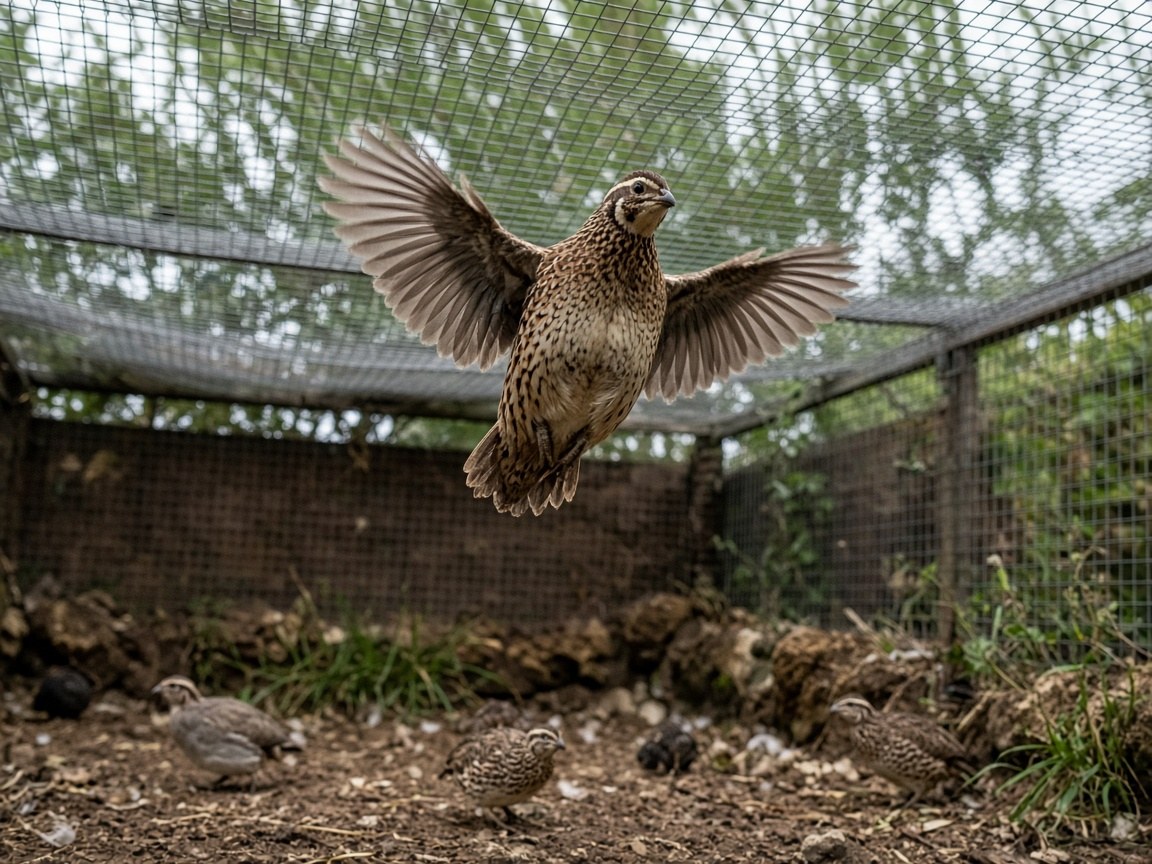
The flush, in plain language
Wild quail sit tight, then burst upward and away when a predator is too close. Domestic coturnix kept their upward burst even though they live in boxes. NSW DPI tells keepers to give cages a solid metal or plywood roof specifically “to minimise head injuries if the birds take fright.” The RSPCA research-animal guidance describes the same vertical escape flight and the head injuries that follow when the roof is hard.
In hobby writing this is often called popcorning. The word is informal; the motion is a nearly vertical takeoff, sometimes repeated if the fright continues. It can involve the whole flock at once.
This is not the same as calm, short hops toward a feeder, or a bird stepping onto a low perch (coturnix are not true roosters of the chicken kind; they sleep in cover, which is discussed in behavior guides). A flush is sudden, explosive and often silent at first, then followed by thuds and alarm calls.
Why a “medium” cage is the dangerous one
Height changes the physics.
| Ceiling style | What happens in a flush | Verdict |
|---|---|---|
| Low, about 8–12 inches (ICAR-CCARI commercial cages are about 25 cm / 10 inches) | Birds cannot get a full vertical run-up | Safe design if ventilation and welfare still work; a hard roof is less dangerous because speed is low |
| The middle zone, roughly 18 inches to 5 feet, with a hard roof | Birds get airborne and hit at speed | The injury zone. This is the height of many leftover rabbit hutches |
| Walk-in, about 6 feet or more, with soft net or a liner under a hard roof | Birds may flush but can stall or hit something forgiving | Safe if the net is tight enough for predators and cannot entangle heads |
| Solid hard roof at walk-in height with no liner | A flush can still mean a hard impact | Add net or padding under the roof |
The RSPCA recommends at least 30 cm (12 inches) of headroom plus a soft or flexible roof and cover. That is compatible with the “low or truly tall, never medium and hard” rule: a 12-inch cage should not also have a rigid, unforgiving lid that birds can crack themselves on, and a taller pen should not be a hard ceiling at chest height. If you take only one idea from this article, make it remove the mid-height hard roof.
What sets a flush off
Common triggers in a backyard:
- A person appearing suddenly over the cage, especially from above
- A dog, cat, hawk shadow, or a child running at the pen
- A loud noise, door slam, or night predator rattling the wire
- Reaching in from the top rather than a side door
- Lights flicked on in a dark room
- Catching or chasing a bird in the pen
- A new bird, a fight, or a male chasing hens
- Moving the cage, or a tractor bump
Chicks do it too, and in a brooder they pile in corners as well as jumping. Rounded corners and calm movement, already emphasized by Poultry Extension, reduce both piling and frantic jumping.
Night flushes are especially ugly: birds hit the roof in the dark and you find injuries in the morning. A solid visual barrier on the sides, a night light that is dim rather than a sudden bright lamp, and a predator-proof, quiet location help. So does not shining a flashlight down through a wire lid at 11 p.m. unless you must.
How to prevent head injuries
- Fix the roof first. Low and tight, or tall and netted. Pad a hard lid you cannot yet replace with a tight, soft liner that still allows air and cannot be eaten or tangled.
- Change how you approach. Come from the side, speak before you appear, crouch rather than looming.
- Add cover. Hides, a leafy branch they cannot get stuck in, or an opaque panel give birds a place to run horizontally instead of up. RSPCA specifically recommends cover to reduce fear.
- Stop the predator show. If a dog can nose the wire, the birds will flush all day. Use a barrier and see predator-proofing.
- Do not catch birds in mid-panic. Wait, darken the area slightly, and use a towel or a dim-corner catch, not a chase.
- Watch the social mix. Males in a tight space add chasing, which adds flushes. See bachelor pens and fighting.
- Keep daily life predictable. Same feeding time, no radio blast on top of the cage, no slamming the hutch door.
If a bird is already scalped or bleeding from the head, treat it as an injury: separate, keep the wound clean, and use the steps in the scalping article. A hard hit can also cause a concussion-like stun; a bird that cannot stand needs a quiet, safe box and, if it does not recover, veterinary help.
What jumping is not
- Not usually a seizure if the bird explodes upward once when you walk up and then is normal. Repeated falling, paddling, or a twisted neck is a different problem and belongs with a health check, not a roof adjustment.
- Not proof they “need to free range.” Unsupervised ranging adds hawks and escape; see can quail free range.
- Not solved by a higher hard cage “so they can fly a little.” That is the injury zone.
- Not solved by wing clipping alone. Clipping may reduce lift, but a panicked clipped bird can still slam a hard lid, and clipping does not fix fear.
Troubleshooting
| Problem | Likely trigger | Fix |
|---|---|---|
| Thumps every time you walk in | You appear from above, or the roof is mid-height and hard | Change approach; rebuild the roof |
| Injuries only at night | Predator, headlights, or a sudden lamp | Lock down the run; add a visual skirt; use dimmer lighting |
| One bird jumps, then all jump | Group flush | Reduce the first startle; add hides |
| Chicks bouncing in a tote | Startle plus slick floor and a lid | Calmer handling; a secure, ventilated lid they cannot crack themselves on; traction |
| Males jump during fights | Social, not only housing | Split males; still fix the roof so fights are not also skull injuries |
Frequently asked questions
Is a 16- or 18-inch pet cage tall enough if I add padding?
It is still in or near the zone where birds can get a run at the lid. Padding helps compared with bare metal, but a lower ceiling or a truly tall, netted pen is the cleaner design. If you must use that height short-term, pad well, add hides, and plan a replacement.
Why do they jump more in a new cage?
Everything is a startle at first, and they have no known hiding place. Cover, a calm first day, and a correct roof matter more in week one than in a settled pen.
Can I train quail not to jump?
You can habituate them to your voice, your clothes and a side-door routine so they flush less often. You cannot reliably train out the reflex itself. Design the cage for the bird you have.
Do button quail or bobwhite do the same thing?
Many quail species flush. Housing still needs a safe ceiling. Species comparisons are in button vs coturnix and coturnix vs bobwhite; this article is about coturnix.
Should I worry if they jump but no one is bleeding?
Yes, a little. A thud that does not break skin can still be a hard hit. Fix the roof and the startle before you get a visible wound.
Sources
- Randall, M. and Bolla, G. Raising Japanese quail. NSW DPI, via The Poultry Site (solid metal or plywood roofs to minimise head injuries when birds take fright).
- RSPCA research-animal guidance on quail, as cited in the site’s scalping article (vertical escape flight; serious head injuries; at least 30 cm headroom; soft or flexible roof; cover to reduce fear).
- ICAR-CCARI cage height (about 25 cm) used as an example of a commercial low ceiling, consistent with the site’s housing guide.
- Raising Japanese Quail in Small and Backyard Flocks, Jacob and McCrea, Poultry Extension (startle piling in chicks; flighty young birds).