
Quick answer: Can you keep male quail together? Sometimes, in a bachelor pen with no hens nearby, enough space, and birds of similar age, but it is not as reliable as a hen-only group or a single-male breeding pen. Coturnix males are territorial. NSW DPI notes that they will defend their home against intruders, and extra males are a classic cause of fighting, scalping and stressed hens. If you try a bachelor group, give more than the usual space, multiple hides and at least two feeders, and be ready to split them at the first serious injury. Do not park a bachelor cage next to laying hens.
Can you keep male quail together is the question that appears as soon as a straight-run hatch grows up. You suddenly have more males than a breeding ratio can use, and you do not want to process them all on the same afternoon. This guide covers when a bachelor pen can work, why it fails, how to set one up, and what to do instead. It is a companion to why quail are fighting and the breeding ratio article, not a replacement for them.
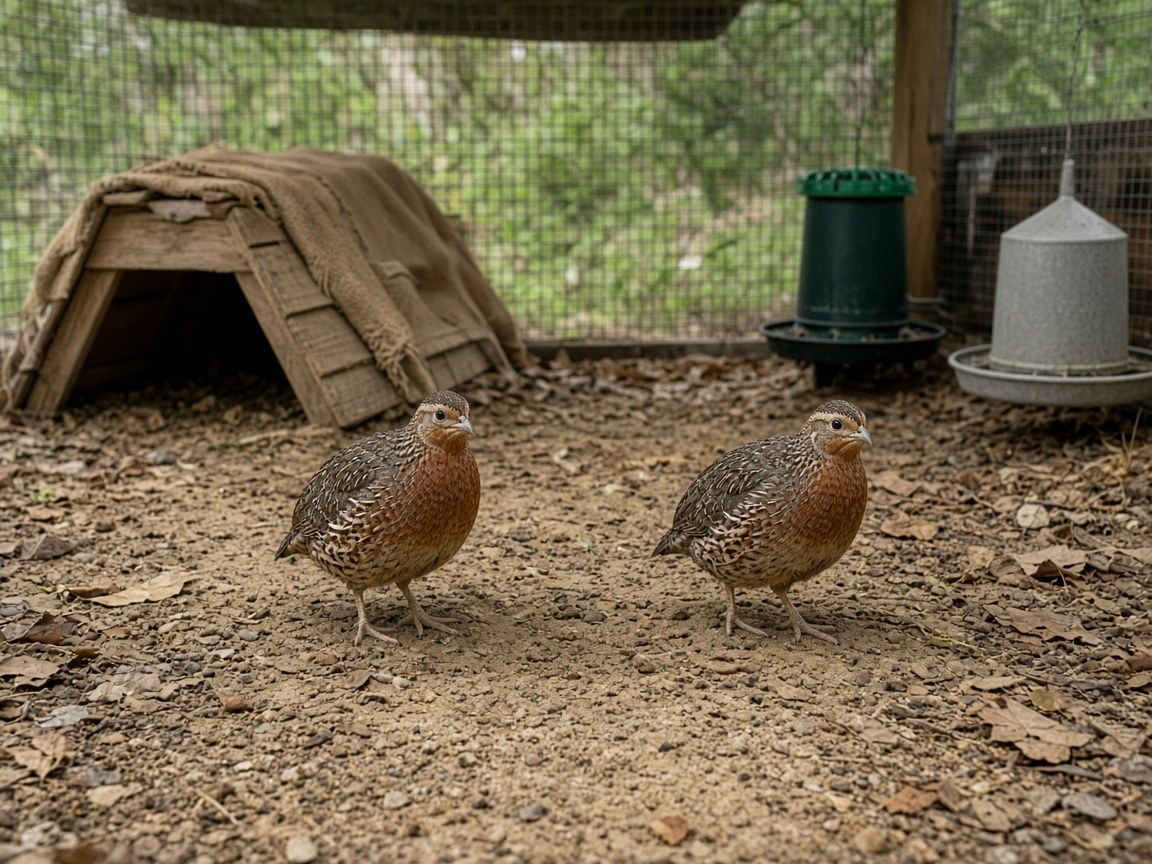
Why males fight
Mature coturnix males compete for territory and for hens. Poultry Extension recommends only eight hours of light for males not kept for breeding, and for meat birds, because longer days encourage sexual maturity, fighting and mating. NSW DPI describes Japanese quail as territorial and willing to defend a home range against intruders. Put those two facts in a small, bright cage with mixed-age males, and you get what keepers call a bachelor disaster: chasing, torn napes, scalp wounds, and a bird that cannot get to feed.
Hens in the next cage make it worse. A male can see, hear and sometimes smell a breeding group he cannot reach. He will still display and fight.
A single male with 3 to 5 hens is the standard backyard breeding setup. Two males in that same small pen is the usual mistake. If you need more than one male for fertility, use separate breeding pens, not a crowd.
When a bachelor pen is most likely to work
| Factor | Better odds | Worse odds |
|---|---|---|
| Age | Raised together from young, split before serious testosterone-fueled fights | A new adult dropped into a settled group |
| Housing | Roomy pen, low or netted roof, several hides, two+ feeders and waterers | A tight cage with one dish and nowhere to break line of sight |
| Nearby hens | None in sight or earshot if you can manage it | Bachelor cage stacked on a breeding cage |
| Light | Shorter day length for non-breeding males (Extension’s 8-hour example) | Long, bright days meant to keep hens laying |
| Numbers | A small group you can actually watch | A dense pile of leftover males “for now” |
| Your plan | You will process, rehome, or split at the first injury | You hope they will “work it out” |
“Work it out” is not a plan. Some groups settle into a peck order and only tussle at the feeder. Others injure a bird in minutes. You only know by watching, especially at first light.
How to set up a bachelor pen
- Space. Start with more than the usual 1 square foot per adult if you can. Crowding is gasoline on male aggression. The space guide is a floor, not a target, for a bachelor group.
- Break up sight lines. Hides, a low wall, or a planted aviary corner give a chased bird a place to go. A wire box with no cover is a boxing ring.
- Roof. Males still flush. Use a low ceiling or a soft net so a fight plus a jump does not add a scalp wound. See why quail jump and quail scalping.
- Multiple stations. Two feeders and two waterers so a dominant male cannot bench the others.
- Even groups. Adding one small, young male to three large adults is a beating waiting to happen. Add several at once, after quarantine, and preferably into a rearranged pen, following the same mixing ideas as introducing new quail.
- Watch for a week. If one bird is trapped, bald, bleeding, or unable to eat, take him out the same day.
Do not keep a “spare bull” in a tiny crate beside the breeding pen “so you can swap him in.” That bird will be frustrated and often louder, and swaps still need care.
Alternatives to a bachelor pen
- Process meat birds at the usual 6–8 weeks, before male fighting peaks in a tight space. That is often the cleanest answer for extra straight-run males. See when to butcher quail.
- Hen-only egg flocks and a separate, planned breeding pen when you need fertile eggs.
- Rehome surplus males to someone who is actually set up for them, not to another overcrowded cage.
- A second breeding group, only if you have the space and the hens.
If your goal is quiet pets, extra males are usually the wrong animals to keep long term. A hen group is calmer. Male calls are the subject of quail noises and meanings.
Signs the bachelor pen is failing
- Bald or bloody heads, torn backs, missing back feathers from repeated mounting attempts between males
- One bird always in a corner, or staying in a nest box or feeder to hide
- Night or morning deaths after a “pretty active” day
- Loud, nonstop chasing
- A male with an injured eye or a limp who still gets driven
Separate the injured bird, treat wounds, and do not return him to the same group until the housing or the roster changes. A healed bird sent back into the same bully group often returns to the hospital pen.
Troubleshooting
| Problem | Likely cause | Fix |
|---|---|---|
| Peaceful for a week, then a sudden war | A hen came into view, longer days, or sexual maturity caught up | Move the pen; reduce light for non-breeders; split the group |
| Only two males and they still fight | Pairs can be as bad as a group; no third bird to diffuse attention | House them alone, or process/rehome one |
| Fighting at the feeder only | Too little space at the dish | Add a second feeder and more room |
| You need two males for 12 hens | Ratio and housing, not a bachelor question | Split into two breeding pens at 1:3–5, do not put both males in one box |
| New male was “fine in quarantine” and is now beaten | Different social setting | Quarantine tests disease, not compatibility |
Frequently asked questions
Can I keep two males if I have a large aviary?
A roomy, well-covered aviary with no hens and lots of cover is the best-case bachelor setup. It can still fail. Build a divider from the start so you can split the pen without a weekend construction project.
Will they be calmer if I leave one hen with a group of males?
That is usually worse, not better. Several males and one hen is a classic over-mating problem for the hen.
Can I house a male with button quail or chicks to “keep him company”?
No. Species and ages should not be mixed to solve a lonely-male problem. Chicks will be hurt.
Do I have to cull extra males?
You do not have to, but you do have to house them humanely. If you cannot, processing for meat or a genuine rehoming plan is kinder than a chronic fight cage.
At what age should I separate males from the grow-out group?
Watch from about 4–6 weeks, when sexing becomes easier on many Pharaoh-type birds and when sparring ramps up. Split as soon as chasing is no longer “play.” Use male vs female signs to sort them.
Sources
- Raising Japanese Quail in Small and Backyard Flocks, Jacob and McCrea, Poultry Extension (8-hour light for non-breeding males and meat birds to limit fighting and mating).
- Randall, M. and Bolla, G. Raising Japanese quail. NSW DPI, via The Poultry Site (territorial behavior; combining groups in an unfamiliar pen).