
Quick answer: Can quail free range the way backyard chickens do? For coturnix, the practical answer is no, not unsupervised. They fly well, they do not reliably come when called, and they are easy prey for hawks, cats, dogs and raccoons. A covered tractor, a fully netted run or short, watched outings are the safer ways to give them fresh ground. Open-yard free range is how many first flocks disappear in a single afternoon.
Can quail free range is one of the first questions people ask after keeping chickens. Coturnix look small and “ground-dwelling,” so it is easy to assume they will potter around the yard and return to a coop at dusk. The research and extension picture is different. Japanese quail retain a strong upward flush when startled, they are small enough for a wide list of predators, and they will hide eggs in litter instead of using a nest box. This guide covers why true free range usually fails, what supervised or tractor-style ranging can look like, the legal catch, and how to offer forage without turning the flock loose.
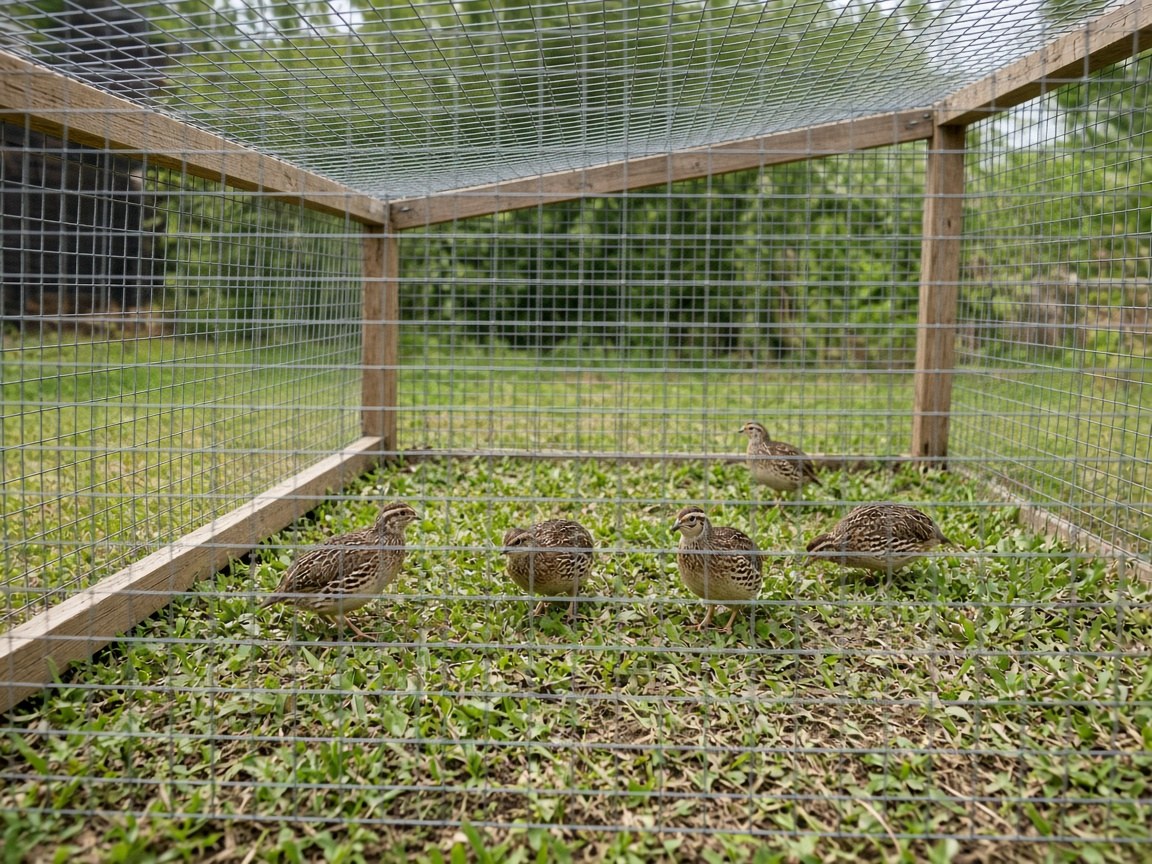
Why coturnix are poor free-range birds
Chickens were bred for centuries to forage near people and to use a house. Coturnix kept in the United States are a domesticated Japanese quail, but they still react like a game bird when they panic: they explode upward, then try to get into cover.
Several points follow from that, and from extension housing advice:
- They fly. Adult coturnix can clear a fence that would hold standard chickens. A 4- or 5-foot poultry net, open at the top, is not a boundary.
- They do not herd home reliably. Keepers who have tried recall training sometimes succeed with very tame birds in a quiet yard, but it is not a method you should bet the flock on. Once a bird is over a fence or in a neighbor’s hedge, you may not get it back.
- Predators are the main loss. The Cooperative Extension predator guide lists dogs, coyotes, cats, foxes, raccoons, weasels, skunks, opossums, snakes, hawks and owls as threats to poultry. Coturnix are bite-sized for most of that list. Even a covered run needs ½-inch hardware cloth, not chicken wire, as explained in the predator-proof quail coop guide.
- Eggs go missing. Poultry Extension notes that Japanese quail kept in community pens will not build nests; they hide eggs in the litter. On open ground you will spend more time hunting eggs than collecting them, and some will stay dirty or get eaten.
- Weather and toxins. Loose birds can pile in a corner in a storm, get into puddles of standing water, or peck at treated lawn, slug bait or poisonous plants.
NSW Department of Primary Industries also warns that startled quail injure themselves on hard roofs, which is why housing should have a solid or padded top. That same flush behavior is what sends a “free-ranging” bird into a tree, a road or a hawk’s path.
What “ranging” can still look like
You can give coturnix fresh grass, insects and sunlight without opening the gate and hoping. The difference is a roof and a floor barrier.
| Setup | How it works | When it makes sense | Main risk if you cut corners |
|---|---|---|---|
| Fully covered attached run | Hardware cloth sides, buried apron, net or solid roof | Everyday outdoor access | Weak roof (hawks) or a gap at ground level (weasels, rats) |
| Quail tractor | A bottomless or mesh-floor mobile pen you move daily | Rotating a lawn or garden bed | Moved too rarely, so the patch turns to mud; no floor mesh where predators dig |
| Walk-in aviary | Planted, netted enclosure they live in | Pet or breeding flocks that should stay calm | Medium height with a hard roof (head injuries) |
| Supervised towel-or-yard time | You stay with a few tame birds for a short period | Hand-tame pets, not a production flock | One startle and they are gone; never use this as the only housing |
| True open free range | No roof, birds come and go | Almost never appropriate for coturnix | Predation and escape, often on the first week |
A tractor should still be fully enclosed, including the top. A chicken tractor with an open or widely spaced top is a hawk feeder. If you use a mesh floor, choose a grid that does not cut feet; if you use no floor, add a hardware-cloth apron or move the pen often enough that a predator cannot dig in overnight. Our quail housing guide compares cages, hutches, ground coops and aviaries if you are choosing a permanent setup instead.
Ground time vs hygiene and parasites
Fresh ground is not automatically healthier. Birds on soil pick up more insects and greenery, which is good enrichment, but they also pick up coccidia, worms and wet-litter bacteria if the same patch is used until it is bare and muddy. That is the trade-off covered in raising quail on the ground vs a raised hutch.
If you use a tractor:
- Move it before the grass is gone and the dirt is slick.
- Keep drinker spills off the ground as much as you can.
- Do not follow a sick group onto a fresh pasture and then bring a new group to the old patch without a rest.
- Still offer a dry dust bath; wet soil is not a substitute. See the quail dust bath guide.
Raised hutches stay cleaner and make eggs easier to collect. Many egg-focused keepers never range their birds at all, and the birds still live well if space, shade, dust bathing and a varied diet are right.
Legal and neighbor issues
Loose quail can become a legal problem even when your city allows a caged flock.
- An escaped bird is still your animal if it walks into traffic or a neighbor’s garage.
- Some ordinances define “at large” poultry the same way they define at-large dogs.
- In a few states, releasing quail, even by accident, can overlap with wildlife or game-bird rules. Coturnix are domestic birds, but “I let them out” is a weak defense.
- Free-ranging also raises conflict with dogs, kids and vegetable gardens.
Check local quail laws first. If the rule is “must be confined,” a tractor with a roof usually counts as confinement; an open yard does not.
A safer outdoor checklist
- Roof or knotted net on every outdoor pen, with no hawk-sized holes.
- ½-inch hardware cloth on the sides, and a buried or apron barrier against diggers.
- Shade and a wind break; coturnix handle cold better than they handle heat and wet.
- A way to lock birds in a tight shelter at night even if they spend the day in a run.
- Enough space so moving a tractor is a daily habit, not a weekend chore.
- No unsupervised mixing with chickens. Quail and chickens should be housed apart.
Troubleshooting
| Problem | Likely cause | Fix |
|---|---|---|
| Birds vanished from a “secure” yard | Flight over an open-top fence, or a day-hunting hawk or cat | Close the top; retire open-range plans |
| Birds are in the pen but eggs are not | Hidden in grass or eaten | Collect more often; add an egg-roll or a nest area you can actually search; consider a raised cage for layers |
| Mud and dirty vents | Tractor left in one spot, or a leaking drinker | Move daily; raise the waterer; rest the patch |
| Head wounds after outdoor time | Flushing into a hard, mid-height roof | Use a low ceiling or a soft net; see why quail jump straight up |
| Neighbors saw “wild birds” in their garden | Escape through a gap or open-top tractor | Repair the pen; do not try recall as your only plan |
Frequently asked questions
Can I clip coturnix wings and then free range them?
Wing clipping can reduce lift, but it is not a complete answer. Clipped birds can still hop, get through gaps and are just as easy for a cat or hawk to catch. If you clip, do it as a backup inside a covered run, not as permission to open the yard.
Do coturnix forage enough to cut the feed bill?
They will eat weeds, seeds and insects, but a laying hen still needs a complete feed. Treat forage as enrichment and a small supplement, not a replacement. Our what do quail eat guide covers how treats should stay limited.
Will a livestock guardian dog make free range safe?
A good dog can deter some ground predators, but not hawks, and not the bird’s own urge to fly into the next yard. Guardian animals do not turn coturnix into chickens.
What about button quail or bobwhite?
This article is about coturnix. Bobwhite are a different species, often held under tighter game-bird rules, and button quail are smaller still. Neither is a better candidate for an open suburban yard. See coturnix vs bobwhite and button quail vs coturnix if you are choosing a species.
Is a covered run still worth it if I cannot free range?
Yes. Outdoor light, grass under a tractor and a dust bath improve the birds’ day without the usual losses. Think “safe outdoor access,” not “free range.”
Sources
- Raising Japanese Quail in Small and Backyard Flocks, Jacob and McCrea, Poultry Extension (cages vs community pens, hidden eggs, flighty chicks).
- Randall, M. and Bolla, G. Raising Japanese quail. NSW DPI, via The Poultry Site (solid roofs to limit head injuries; secure housing).
- Cooperative Extension predator guidance, as summarized in common small-flock predator lists used in the predator-proofing article.