
Quick answer: How much do quail eat per day? NSW Department of Primary Industries reports that adult Japanese quail eat about 14–18 grams of feed a day. Heavier lines eat more: ICAR-CCARI lists about 30–35 g a day from six weeks for its heavier birds, and a backyard planning figure that includes some spillage is 20–30 g per adult per day. Chicks eat much less at first, then ramp up. Texas A&M AgriLife Extension says a meat quail needs about 3 to 3.5 lb of feed for the whole grow-out. Use those numbers to size a bag, not a guess from chicken feeding charts.
Quail feed consumption per day is the number you need when you are asking how long a 50-pound bag will last, what a dozen hens cost to feed, or whether your feeder is wasting more than the birds are eating. This article pulls the published intake figures into one place, shows how to turn grams per bird into pounds per month, and explains why a messy feeder can double what “the bag says.” It is not a diet formulation guide; for protein and ingredients see what do quail eat and quail feed protein percentage.
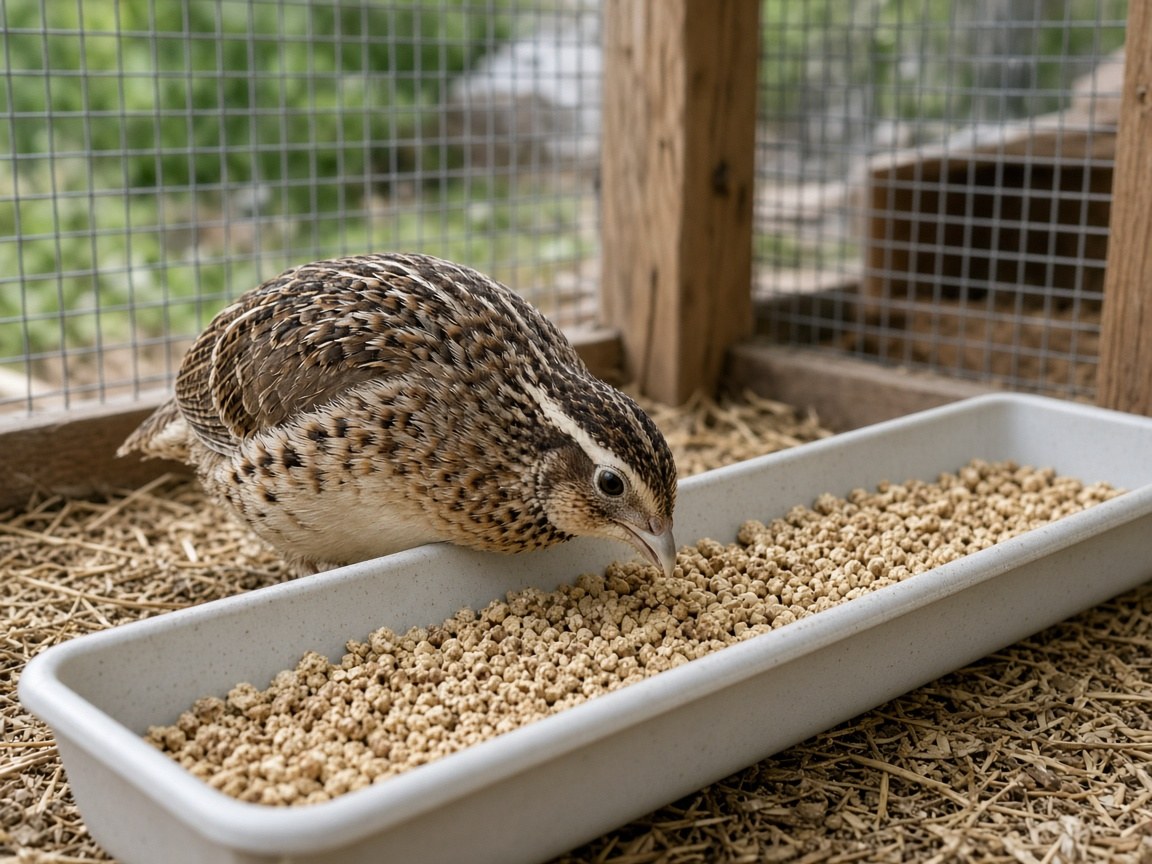
Published intake figures, side by side
Different sources measure different birds. That is why one forum will say “half an ounce” and another will say “over an ounce.”
| Source and bird | Intake | How to use it |
|---|---|---|
| NSW DPI, adult Japanese quail | 14–18 g per bird per day | A tight, research-style figure for standard adults with little waste |
| ICAR-CCARI, heavier birds from 6 weeks | 30–35 g per bird per day | Use for jumbo or heavy meat lines, not for a small egg-type hen |
| Practical backyard planning (with some waste) | 20–30 g per adult per day | Useful for ordering bags for a mixed pet or egg flock |
| Texas A&M AgriLife, meat quail, whole grow-out | About 3–3.5 lb of feed per bird | Budget a meat batch from hatch (or arrival) to processing, not a daily spoonful |
Fourteen to 18 grams is about 0.5–0.6 ounces. Thirty grams is a little over an ounce. The birds are small; the monthly total still adds up once you have a dozen of them, especially if the feeder leaks a pile onto the floor every day.
Jumbo and Texas A&M-type meat birds sit at the high end. Standard Pharaoh-type layers sit closer to the NSW range if the feeder is efficient. Compare body size in jumbo vs regular coturnix before you use a heavy-line figure on a small hen.
From grams per day to a bag and a month
A simple formula:
birds × grams per bird per day × 30 ÷ 453.6 = pounds per month.
| Flock | If they eat 18 g/day | If they eat 25 g/day | If they eat 35 g/day |
|---|---|---|---|
| 6 adults | About 7 lb/month | About 10 lb/month | About 14 lb/month |
| 12 adults | About 14 lb/month | About 20 lb/month | About 28 lb/month |
| 24 adults | About 29 lb/month | About 40 lb/month | About 56 lb/month |
A 50 lb bag at 25 g/day for 12 adults lasts about 2½ months of feed, not counting the starter you already used on chicks and not counting what you sweep up as waste. Store that bag in a sealed container. NSW DPI notes that feed stored longer than 8 weeks is subject to vitamin loss and rancidity, especially in summer, so buying a giant bag for three birds can be a false saving.
For money, combine these weights with local prices in how much it costs to raise quail and quail cost per bird.
How much chicks eat (and why it looks like “nothing,” then a lot)
Day-old coturnix eat only a few grams, so the first week can fool you into thinking a small bag will last forever. Intake rises fast with body weight. By the time meat birds are near processing, they are approaching adult intake or more, which is how Texas A&M’s 3 to 3.5 lb total accumulates in six to eight weeks.
A rough planning pattern for a standard chick, not a precise lab curve:
| Stage | What to plan for |
|---|---|
| Week 1 | A small amount per chick; the bigger issue is waste and fouled feed, not running out |
| Weeks 2–4 | Intake climbs quickly as body weight moves from under 50 g toward 100 g |
| Weeks 5–8 (meat or young layers) | Approaching adult grams per day; jumbo lines pull ahead |
| Adult layers in production | Use 14–18 g as a tight figure, 20–30 g if your setup is ordinary, 30–35 g for heavy lines |
Weigh a feeder at the start and end of a week if you want your number. That single measurement, divided by bird-days, is more truthful than any table once waste is included.
What changes intake
- Body size and line. Heavier birds eat more.
- Temperature. Birds eat more in cold weather and often less in heat. Extension discussions of heat stress note that feed intake drops when birds are too hot, which then cuts egg production and calcium intake.
- Lay vs molt vs grow-out. Laying hens need a consistent complete diet. Meat birds eat for growth. Birds in a hard molt may eat differently and lay less.
- Waste. Open troughs filled to the brim, flighty birds scratching feed out, and wet, dumped feed can exceed what the birds swallowed. NSW recommends ample feed but warns that a too-full trough causes excessive wastage, and that after the first week you can lower the level.
- Treats. Mealworms, seeds and kitchen scraps count. If treats crowd out feed, the bag lasts longer and the diet gets worse. Keep extras small, as in what can quail eat.
NSW also gives feeder space of about 1.25–2.5 cm per adult bird. Crowding the lip of one tiny dish means more fighting and more feed on the floor, which you may misread as high appetite.
How to measure your flock without special gear
- Fill a dry feeder and weigh it on a kitchen scale (grams are fine).
- Do not add feed for 24 hours, or record every addition.
- Weigh what is left. Subtract obvious floor waste if you can sweep and weigh that too.
- Divide by the number of birds.
- Repeat on a weekday and a weekend, or in hot and cold weather, before you treat one day as a law.
If the result is 40–50 g per small hen, you are probably measuring waste or rodent theft, not true intake.
Troubleshooting
| Problem | Likely cause | Fix |
|---|---|---|
| Bag empties twice as fast as the table predicts | Spillage, rats, or a jumbo-line appetite | Switch to a no-waste feeder style; rodent-proof storage; confirm bird type |
| Birds eat much less and stop laying | Heat, stale feed, or disease | Check temperature and feed freshness; see why quail stop laying |
| Chicks seem to eat nothing | They have not found the crumble, or it is too large | Floor-feed for a few days; see what baby quail eat |
| Feed bill dwarfs egg value | High waste or an oversized flock for your use | Cut waste first; then revisit flock size in how many quail to start with |
Frequently asked questions
Do I need to ration quail or leave feed out all day?
Most backyard flocks do best with free-choice complete feed and a feeder designed to limit spillage. Timed, tiny meals can leave shy birds short and do not usually save a meaningful amount if the diet is already correct.
How much do quail eat compared with chickens?
Much less per bird, because they are much smaller. Do not use a “quarter pound per chicken per day” chart and scale by guesswork. Use the gram figures above.
Will fermented or soaked feed change the daily amount?
Birds may eat a different wet weight of soaked feed. Compare dry-feed equivalents, and be careful about spoilage. The dry grams of nutrition still need to add up.
Does a hen eat more than a male?
A laying hen has a higher demand for energy and calcium than a non-breeding male, but body size still dominates. A heavy male can out-eat a small hen.
How much water do they drink?
Water intake is not the same as feed intake, but it rises in heat and with dry feed. Provide clean water at all times; NSW specifies that fresh water should always be available. In winter, see how to keep quail water from freezing.
Sources
- Randall, M. and Bolla, G. Raising Japanese quail. NSW DPI, via The Poultry Site (14–18 g/day; feeder space; waste from overfilled troughs; 8-week feed storage).
- ICAR-CCARI. Japanese quail (30–35 g/day from six weeks on heavier stock).
- Texas A&M AgriLife Extension. Quail Production for Home Consumption (about 3–3.5 lb of feed per meat bird per grow-out).