
Quick answer: A quail dust bath is a shallow tray of fine, dry material where quail roll, flick dust through their feathers and shake it out. It helps keep feathers in good condition and is a strong natural need: the RSPCA notes that quail deprived of a bath go through the motions anyway (“vacuum” dustbathing). For coturnix, use a sturdy tray about 2–3 inches deep filled with dry play sand or fine, sifted soil, place it where droppings won’t land in it, keep it dry, sift it every few days and replace it every few weeks. One bath for every 4–6 birds stops queues.
A quail dust bath is one of the cheapest welfare upgrades you can make for coturnix, and one of the most overlooked in wire cages. Quail don’t bathe in water like a songbird; they bathe in dust, and they do it daily. This guide explains why quail dust bathe, what research says about how much time they spend doing it, the best and worst materials, how to build a bath for cages, hutches and pens, how to keep it clean, and when a dust bath is not enough to deal with mites.

Why quail dust bathe
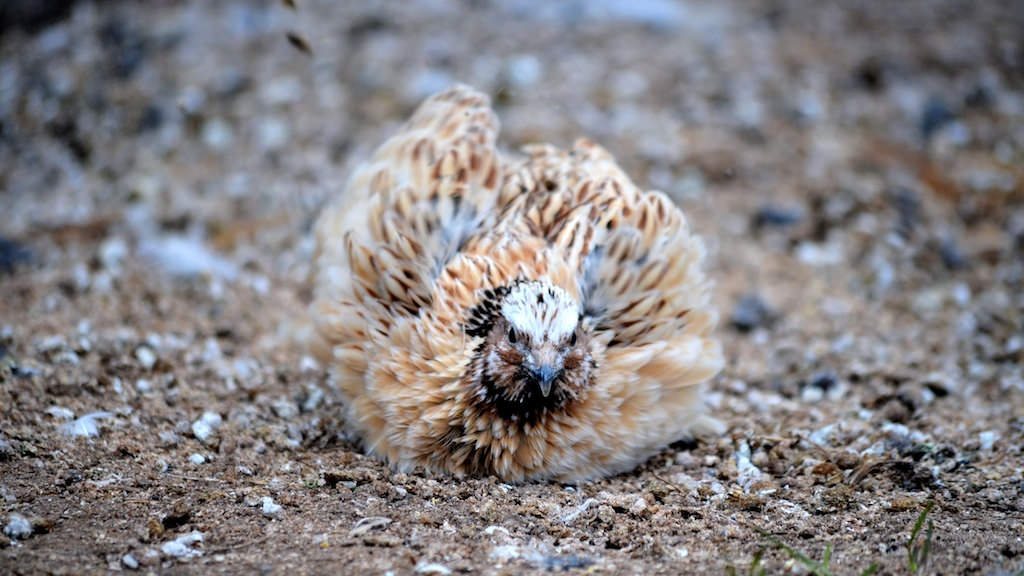
Japanese quail are avid dust bathers. Wikipedia’s species summary describes numerous bouts of dust bathing each day: the bird rakes its bill and legs across the ground to loosen it, tosses dust into the air with its wings, then shakes its body as the dust falls. Here is why it matters:
- Feather condition. The RSPCA’s quail housing guide calls dustbathing an important natural behavior that helps maintain feather quality.
- A strong drive. Birds kept without dust go through the full sequence on a bare floor, called vacuum dustbathing. A 2025 review in Poultry Science (Jansson et al.) cites studies showing high levels of dustbathing once quail regain access to a substrate after going without, and vacuum dustbathing in cages without one.
- Less frustration. SPCA New Zealand lists dustbathing among the natural behaviors quail should be able to express, and warns that preventing them can cause frustration.
- Possibly fewer mites. University of Minnesota Extension says dust baths should be available as they help control mites in chickens. The same is likely in quail, but it is a support, not a cure.
How much time do quail spend dust bathing?
The 2025 review cites earlier work finding that quail spent around 10 percent of their time preening and about 4 percent dustbathing. In a 16-hour day, that is roughly 40 minutes. The review also concludes that quail dustbathe if given substrate to do so.
What a dust-bathing quail looks like
New keepers sometimes panic the first time they see it. A dust-bathing quail:
- Lies flat or on its side with wings spread.
- Kicks and rakes material up into its feathers.
- Fluffs up, closes its eyes, and may lie still for a while.
- Then stands up and shakes off a cloud of dust.
Several birds often bathe at once. If a bird lies flat and does not get up when the others move, or is panting, check it; a heat-stressed bird can look like a bather. See coturnix behavior for other normal behaviors.
Best materials for a quail dust bath
The RSPCA notes that domestic fowl prefer bathing in fine materials such as sand rather than sawdust, and that the same may be true for quail.
| Material | Good for quail? | Notes |
|---|---|---|
| Play sand (washed, bagged) | Yes, best all-round choice | Fine, clean, cheap; buy bagged sand meant for children’s sandboxes |
| Fine, dry, sifted garden soil | Yes | Free; dig from an untreated area and sift out stones |
| Sand and soil mix (about 50:50) | Yes | Holds the shape of a “wallow” better than sand alone |
| Peat moss or coir mixed in | Okay in small amounts | Very dusty when dry; use sparingly |
| Wood shavings | Not ideal for the bath | Fine as bedding, too coarse for good bathing |
| Builder’s or coarse sand | Not ideal | Sharp, gritty and may be dirty |
| Wood ash | We don’t recommend it | Fine and dusty; ash is alkaline and can irritate skin and eyes when damp |
| Diatomaceous earth | Use with care, if at all | Very fine dust; avoid breathing it, and it is not a mite treatment on its own |
| Insecticide powder | Only as the label allows | Use only products labeled for poultry, at label rates |
A little dust is the point, but a very dusty shed is not. The same review notes that litter and dust bathing raise dust levels compared with cages. Keep the room well ventilated; heavy dust is hard on the airways. See quail respiratory infection.
How to set up a quail dust bath
| Housing | Container | Depth and size | Tips |
|---|---|---|---|
| Wire cage | Shallow metal or plastic tray, or a cut-down storage tub | About 2 inches deep, at least 8×12 inches | Put it in for an hour or two a day, then remove it |
| Rabbit hutch or solid-floor cage | Heavy tray or low-sided box | 2–3 inches deep | Leave in place and sift often |
| Ground pen or aviary | Corner area edged with boards, or a large tub | 3–4 inches deep, room for several birds | Keep under a roof so rain can’t soak it |
| Brooder (from about 2 weeks) | Jar lid or small dish | About 1 inch | Remove when dirty; chicks also eat sand |
Step by step
- Pick a heavy, low tray quail can step into easily; a ceramic plant saucer or a metal baking tray works.
- Fill with 2–3 inches of dry play sand or sifted soil.
- Place it away from the feeder and waterer so feed and water don’t end up in it, and out from under perches or ledges where droppings fall.
- Add cover nearby, such as a low board or branches, so bathers feel safe.
- Provide enough baths. As a rule of thumb, one tray per 4–6 birds stops queues and squabbles.
- Watch the first sessions. Most quail find it within minutes.
In wire cages, a removable tray for part of each day works well. It gives birds a chance to bathe without letting the sand spill through the wire or soak up droppings all day.
Keeping it clean
| Task | How often |
|---|---|
| Scoop out droppings | Daily, or each time you remove a cage tray |
| Sift through a kitchen sieve or hardware cloth | Every few days |
| Replace all material | Every 2–4 weeks, or sooner if wet or smelly |
| Dry it out | Any time it gets damp; damp sand cakes and grows mold |
| Wash the tray | Each time you replace the material |
A damp, cool patch can be welcome in hot weather. Extension guidance on summer heat notes that a slightly damp dirt or sand floor is a cool and refreshing place to dust bathe, but a soggy one that never dries breeds disease and attracts pests. See raising quail in a hot climate.
Dust baths and mites
A dust bath helps, but it does not cure an established infestation. If you see crawling mites, scabs, dull or broken feathers, or bald patches with irritated skin, treat the flock. Kansas State Research and Extension lists dust-bath boxes as one way to apply some poultry products, but only use products that are labeled for poultry, follow the label exactly, and check whether there is an egg withdrawal time. Many labels do not mention quail, so ask a vet first. Clean the housing too; mites hide in cracks.
For other causes of feather loss, see why quail lose feathers.
Troubleshooting
| Problem | Likely cause | Fix |
|---|---|---|
| Quail ignore the bath | Material too coarse or wet, tray too high, birds nervous | Use dry fine sand, a lower tray, add cover |
| Bath full of droppings | Placed under a perch or used as a bed | Move it; remove after sessions; scoop daily |
| Sand everywhere | Tray too shallow, birds kick it out | Deeper tray with a lip; a box with a side opening |
| Eggs laid in the bath | Hens see it as a nest | Add a covered nest area nearby and collect eggs often |
| Birds bathe in the feeder | No bath available | Provide a bath; use a feeder with a grid |
| Wet, caked sand | Spilled water or rain | Move away from the waterer; keep under cover |
| Dusty shed, sneezing birds | Too much fine material, poor airflow | Less peat or ash, more sand; improve ventilation |
| Bald patches despite a bath | Mites, over-mating or pecking | Check for mites and males; see the feather-loss guide |
Frequently asked questions
Do quail need a dust bath?
It is not essential for survival, but it is an important natural behavior for feather condition and welfare. Quail without one perform “vacuum” dustbathing.
What is the best dust bath material for quail?
Dry, bagged play sand, alone or mixed with sifted soil.
How often do quail dust bathe?
Most days, in several short bouts. Research cited in a 2025 review found about 4 percent of their time was spent dustbathing.
Can quail use the same dust bath as chickens?
Yes, if they live in separate housing and you move the tray between them, but shared baths can spread mites and disease. Separate baths are safer. See our quail housing guide.
Can baby quail dust bathe?
Yes. Chicks start trying it early. Offer a shallow lid of sand from about 2 weeks, and watch that they don’t eat too much.
Should I add diatomaceous earth to a quail dust bath?
It is optional and often overrated. It is very dusty, and it is not a treatment for an established mite problem.
Sources
- Jansson DS, Hedman FL, Yngvesson J, Keeling L, Henriksen R. A critical review on the welfare of Japanese quail in cage-free housing: Current knowledge and future perspectives. Poultry Science 104 (2025): 105263.
- RSPCA Research Animals Department. Quail: Good practice for housing and care, 4th edition, 2011.
- SPCA New Zealand. Caring for quail.
- University of Minnesota Extension. Raising chickens for eggs.
- Kansas State Research and Extension. Eliminating Mites in Poultry Flocks (MF2387).
- Cooperative Extension. Managing Backyard Chickens During Periods of Extreme Summer Temperature.
- Wikipedia. Japanese quail.