
Quick answer: Do quail eggs need to be refrigerated? In the United States, yes — treat them as you would chicken eggs. The FDA says to refrigerate shell eggs at 40°F or below, store them in the original carton, and use them within 3 weeks for best quality. FDA’s refrigerator storage chart also lists fresh shell eggs at 3 to 5 weeks. That applies to quail eggs you plan to eat, including unwashed backyard eggs if you want the safer option. Hatching eggs are different: keep those cool, not in the household fridge, as explained in how long hatching eggs can sit.
Do quail eggs need to be refrigerated is a food-safety question, not a nesting question. Coturnix eggs are small, but they can still carry Salmonella, and US advice for shell eggs is built around refrigeration, clean handling and thorough cooking. This guide covers store eggs, backyard eggs, washed vs unwashed shells, how long they last, what the counter-storage claims get wrong, and how to handle cooked eggs. For collecting and general egg use, see the quail eggs guide.
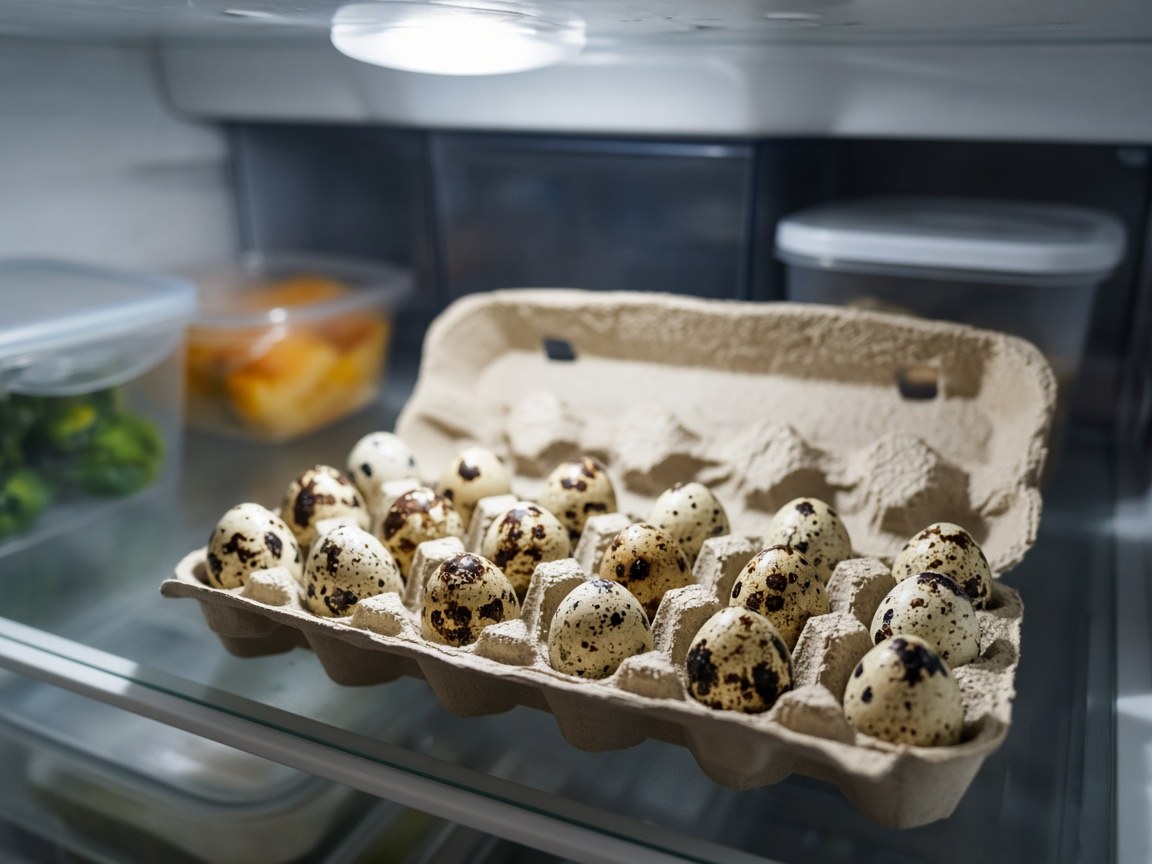
What official US guidance actually says
The FDA’s egg-safety page is written for shell eggs as food:
- Store promptly in a clean refrigerator at 40°F or below, and use a thermometer to check.
- Store eggs in their original carton and use them within 3 weeks for best quality.
- Use hard-cooked eggs, in the shell or peeled, within 1 week.
- Do not leave cooked eggs or egg dishes out more than 2 hours, or more than 1 hour if the temperature is above 90°F.
- Cook eggs until yolks are firm, and cook dishes containing eggs thoroughly.
FDA’s refrigerator and freezer storage chart lists fresh in-shell eggs at 3 to 5 weeks in the fridge, and says not to freeze eggs in the shell. USDA FSIS uses the same 40°F refrigerator target and the 3- to 5-week window for raw shell eggs in its farm-to-table egg materials.
None of that is written as “chicken only.” A quail egg is still a raw shell egg.
Store-bought vs backyard eggs
Grocery quail eggs in the US have usually been washed and kept cold in the supply chain. Once an egg is refrigerated, it should stay refrigerated. Taking a cold carton out for a long party on the counter invites condensation on the shell, which can help move bacteria inward, and it lets the eggs warm into the temperature range where bacteria grow faster (FDA flags the 40–140°F zone in its serving advice).
Backyard eggs still belong in a 40°F refrigerator if you are following US food-safety advice. Utah State Extension, among others, recommends refrigerating farm-fresh eggs at 40°F or below even if they are unwashed, because Salmonella can be inside an egg as well as on the shell. The bloom (cuticle) helps, but it is not a guarantee.
A practical backyard routine:
- Collect eggs often, especially in summer, so they do not sit in a hot cage.
- Set aside cracked or heavily soiled eggs. Cook obviously dirty ones only if you can clean them and use them soon, or discard them.
- Dry-clean lightly dirty eggs with a brush or fine abrasive rather than soaking them, or wash in water warmer than the egg if you do wash, then refrigerate. (The quail eggs article walks through collection and dry-cleaning.)
- Refrigerate in a labeled carton on an inside shelf, not in the door.
- Use older eggs first.
If you sell eggs, follow your state egg rules; some require washing, grading or refrigeration. See selling quail eggs.
How long quail eggs last
Use the official egg windows, and be a little more conservative if you do not know the lay date.
| Form | Refrigerator (40°F or below) | Notes |
|---|---|---|
| Raw, in shell, store carton | Best quality within 3 weeks of bringing them home; official charts also list 3–5 weeks | Check the pack or expiration date, but dates are not a substitute for time and temperature |
| Raw, in shell, backyard, known lay date | Aim to use within 3 weeks; 3–5 weeks is the common US shell-egg range | Write the date on the carton |
| Hard-cooked, peeled or in the shell | Use within 1 week | Cool quickly, then refrigerate |
| Leftover cooked egg dishes | 3 to 4 days | Reheat to 165°F |
| Raw egg out of the shell (yolks/whites) | A few days (FDA chart: 2–4 days) | Keep covered |
| Frozen, out of the shell | Up to 1 year for quality | Do not freeze in the shell; beat whole eggs before freezing |
The float test is a quality clue, not a safety test. An older egg can stand or float because the air cell has grown, and it may still be usable for baking — or it may be spoiled. Smell and appearance after cracking matter more. When an egg smells off, is watery and pink, or looks unusual, throw it out.
The counter-storage argument, fairly put
In some countries, supermarket eggs are unwashed and often stored at room temperature. That system is not the US system. US commercial eggs are typically washed, which removes much of the bloom, and the cold chain is part of official safety advice.
For unwashed backyard eggs, some keepers leave them on a cool counter for a short time. If you do that, you are accepting more risk than the FDA’s “refrigerate promptly” advice, especially in a warm kitchen, a house with young children, older adults, or anyone with a weaker immune system, and in summer. Once the eggs have been refrigerated, do not “re-temper” them on the counter for days.
Hatching eggs are stored cool (often in the 50s°F) and unwashed, then incubated. That is not a food-storage method. Do not use a hatching box as your breakfast cupboard.
Cooking and serving
Small yolks cook faster than chicken yolks; times are in how long to boil quail eggs. Safety still means firm yolks for people who need the extra caution, and 165°F for leftover dishes. Pickled eggs have their own acid and jar rules in the pickled quail eggs recipe.
Wash hands, tools and surfaces after handling raw eggs, the same as for any raw poultry product.
Troubleshooting
| Problem | Likely cause | What to do |
|---|---|---|
| Sweaty carton after a car trip | Cold eggs in warm, humid air | Refrigerate again; cook sooner; use eggs that stayed clean and uncracked |
| Sulfur smell when boiled | Overcooking, or an older egg | Follow the boiling times; if the smell is rotten rather than just “eggy,” discard |
| Watery whites | Older eggs | Still usable for some cooking if they smell normal; use fresher eggs for poaching |
| You forgot a bowl of boiled eggs on the table | Time in the danger zone | If they sat out more than 2 hours (1 hour above 90°F), throw them away |
| Unsure of backyard lay dates | Mixed cartons | Start dating cartons; use the oldest first; when in doubt, crack into a cup before adding to a dish |
Frequently asked questions
Can I leave unwashed quail eggs out overnight and refrigerate in the morning?
Collecting in the evening and refrigerating that day is reasonable. Leaving them on a warm counter for a full day is a weaker plan than the official “promptly refrigerate” advice, especially in summer.
Do quail eggs last longer than chicken eggs because the shell is thicker?
People often say so, but you should not stretch official refrigerator times on that belief. Use the same 3-week best-quality window and the same 3- to 5-week chart.
Should I wash every egg before it goes in the fridge?
Not necessarily. Dry-cleaning is enough for lightly dirty shells. If you wash, use running water warmer than the egg, dry them, and refrigerate. Do not soak eggs in a standing bowl of cold water.
Can I freeze leftover quail eggs?
Yes, out of the shell. Beat whole eggs, pack them tightly, label the date, and use them in cooked dishes later. Do not freeze eggs in the shell.
What about mayonnaise or cookie dough?
Use cooked or pasteurized egg products when a recipe will not be cooked, especially for people at higher risk. Homemade raw-egg sauces are a safety choice, not a tradition you have to keep.
Sources
- U.S. Food and Drug Administration. What You Need to Know About Egg Safety (40°F; 3 weeks for best quality; 1 week for hard-cooked; 2-hour / 1-hour serving limits).
- FDA. Refrigerator & Freezer Storage Chart (fresh in-shell eggs 3–5 weeks; hard-cooked 1 week).
- USDA Food Safety and Inspection Service. Shell Eggs from Farm to Table.
- Utah State University Extension. How Can I Tell if Eggs Have Gone Bad? (refrigerate farm-fresh eggs; 3–5 weeks; bloom is not a complete guarantee).