
Quick answer: How long can quail eggs sit before incubating? Set coturnix eggs as fresh as you can, ideally within 3 to 7 days of laying. Penn State guidance for holding game-bird eggs (via AgMRC’s bobwhite production bulletin) says hatchability declines when eggs are held longer than about 7 to 10 days. Store them cool, not cold — 55–65°F in that Penn State range, or the 45–55°F poultry range in University of Missouri’s G8353 — with the pointy end down, and do not use a household refrigerator. A short rest after shipping is useful; a two-week wait on the counter is not.
How long can quail eggs sit before incubating is one of the levers that decides your hatch before the machine is even turned on. The incubation guide already mentions a short storage window; this article is the deeper version: how hatch rates fall by day, how to store eggs if you must collect a full setting, how to handle shipped eggs, and why the kitchen fridge is the wrong tool. Japanese quail eggs are small, so they have little margin for drying out or getting too cold.
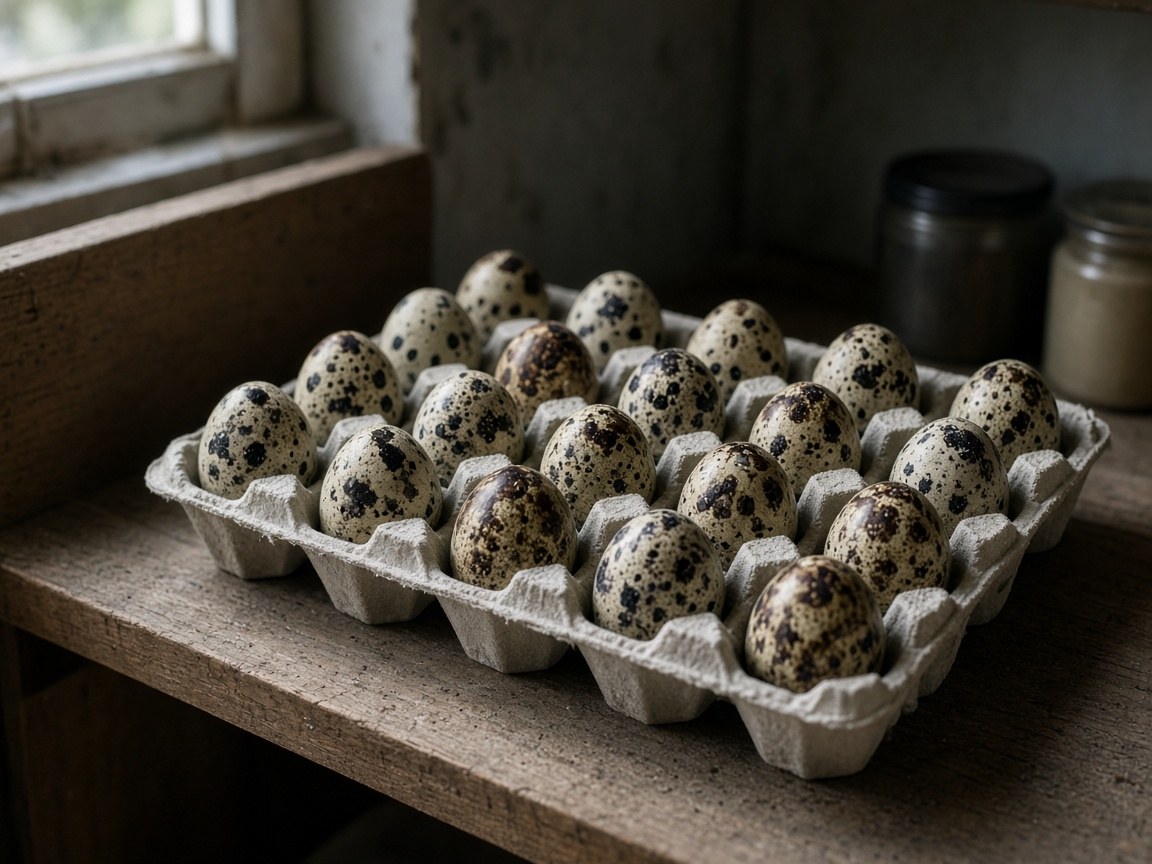
The short window that preserves hatchability
There is no single official “coturnix-only” storage table in every extension bulletin, so it is honest to use the best nearby guidance and label it.
- Penn State / AgMRC bobwhite production: keep eggs at an ambient 55–65°F before setting; it is best to set them within 3 to 7 days after they are laid; they can only be held about 7 to 10 days before hatchability decreases.
- University of Missouri G8353 (poultry eggs): a common storage recommendation is 45–55°F with fairly high humidity, and hatchability falls as storage lengthens.
- Mississippi State, on bobwhite: plan so eggs are not stored longer than 10 days; store pointy end down; if held more than 3 or 4 days, tilt or turn them; do not use a room air conditioner as your “cooler,” because it dries the air.
For backyard coturnix, a practical rule that stays inside those sources is: set by day 7 when you can, treat day 10 as a stretch, and expect a weaker, later hatch after that.
| Days from lay to set | What to expect | What to do |
|---|---|---|
| 0–3 | Best hatch potential, all else equal | Collect clean eggs and set as soon as you have a full group, or hold them correctly until the incubator is ready |
| 3–7 | Still the recommended window | This is the normal “save a setting” period |
| 7–10 | Hatchability starts to drop | Set them if that is your only batch; do not add another week “to wait for more” |
| 10–14 | Further decline; more early deaths and late, weak chicks | Use only if you accept a worse hatch; do not mix these with very fresh eggs without noting the difference |
| Over 14 | Often a poor use of incubator space | Cook the extras as food, or keep a smaller, more frequent hatch schedule |
A 70% hatch of fresh fertile eggs can look like a 40% hatch after a long hold even when the incubator is perfect. Diagnose storage before you buy a new machine.
How to store the eggs while you wait
- Temperature. Cool closet, basement or a dedicated egg cooler in the 50s°F is the goal. A household refrigerator, at about 40°F or below (FDA’s food-storage temperature), is too cold for embryos you still want to hatch.
- Humidity. Eggs dry out in dry air. Missouri’s poultry guidance calls for fairly high humidity in storage. A room air conditioner is a poor “egg cooler” because it strips moisture; Mississippi State makes that point for quail egg holding.
- Position. Store pointy end down so the air cell stays in the right place.
- Turning or tilting. If you hold eggs more than a few days, tilt the carton to the opposite slant once or twice a day, as incubation guides recommend, so the yolk is less likely to stick.
- Clean, unwashed shells. Dry-pick off lumps. Do not wash. Washing removes the cuticle.
- No kitchen counter in summer, no hot garage, no sunny window. Heat starts development and then stalls it, which is a classic cause of early death when you finally incubate.
Collect often, especially in hot weather, so eggs do not sit in a laying cage all afternoon. Dirty, cracked, very small, very large or odd-shaped eggs should not go into the holding carton.
Shipped eggs are a special case
Shipped hatching eggs have already been jolted and, often, chilled or overheated in transit. The usual hatchery advice (including Meyer Hatchery’s coturnix incubation guide) is to let them rest about 24 hours at room temperature, pointy end down, before they go into the incubator. That rest is not an extra week of storage. It is a pause so the air cell can settle and so cold eggs do not sweat when they hit a warm, wet incubator.
If a shipment arrives late, you cannot unwind the clock. Rest them, set them, and judge the hatch with shipping plus age in mind. Candle later and keep notes rather than immediately blaming the incubator.
Warm eggs to room temperature before setting if they were in a cool store, so they do not sweat from a sudden jump to 99.5°F.
Building a full setting without waiting too long
Coturnix hens lay often, so most backyard flocks can fill a small incubator in a week. If your flock is tiny:
- Run more frequent, smaller hatches instead of holding for three weeks.
- Mark lay dates on the shell in pencil.
- Set the oldest eggs toward the middle of the machine only if you like, but do not expect them to catch up; they may hatch later.
- If you need a large, even hatch, borrow or buy eggs of a similar age rather than holding your own for 16 days.
Hatching eggs and eating eggs should be stored differently. Once you decide an egg is food, refrigerate it as food, as described in whether quail eggs need to be refrigerated. Do not move eggs from the fridge back into a hatching program and expect a good result.
Troubleshooting
| Problem | Storage clue | Fix next time |
|---|---|---|
| Many clears, but you know the male is working | Eggs may have been overheated, over-chilled, or very old | Review holding temperature; set sooner; candle to separate true infertility from very early death |
| Blood rings and early deaths | Stored too warm, too long, or washed | Cooler, shorter hold; no washing |
| Late, drawn-out hatch | Older eggs mixed with fresh ones | Set similar ages together; expect old eggs to be slower |
| Eggs sweat in the incubator | Moved straight from a cold box into a warm, wet machine | Rest at room temperature first |
| Mold on shells | Storage too damp, dirty cartons, or washed eggs | Clean dry cartons; hold clean unwashed eggs; improve collection |
For eggs that complete incubation and still fail, use why quail eggs are not hatching and the candling guide to separate storage problems from machine problems.
Frequently asked questions
Can I store hatching eggs in the refrigerator if I put them in the door or a warmer shelf?
No. A working household fridge is built to stay at or below 40°F. That is the right place for omelet eggs and the wrong place for eggs you still want to hatch.
Do I have to turn stored eggs?
If they will be set within a couple of days, turning is less critical. If you hold them more than 3 or 4 days, tilting the carton once or twice a day is the conservative, source-backed habit.
How long can shipped eggs sit after they arrive?
Rest about a day, then set. Do not add a second week of holding on top of shipping delays unless you have no choice and you accept a weaker hatch.
Is a wine fridge a good egg cooler?
Only if you can hold a mid-50s°F temperature and some humidity, and if the unit is clean and not used in a way that dries eggs out. A cheap, dry mini-fridge that runs at 40°F is just another refrigerator.
Will older eggs hatch if I raise the incubator humidity?
Humidity will not repair an embryo that has already declined in storage. Correct humidity still matters, but freshness matters first.
Sources
- Penn State Cooperative Extension, via AgMRC. Bobwhite Quail Production (55–65°F; set within 3–7 days; hatchability drops after about 7–10 days).
- Lyons, J. J. Small Flock Series: Incubation of Poultry (G8353). University of Missouri Extension (poultry storage temperatures and humidity; do not wash hatching eggs).
- Mississippi State University Extension. Raising Bobwhite Quail for Commercial Use (pointy end down; turn if held more than 3–4 days; 10-day holding limit; do not use a household air conditioner as an egg cooler).
- Meyer Hatchery. Guide to Incubating and Hatching Coturnix Quail Eggs (rest shipped eggs before setting).