
Quick answer: Do quail need a rooster to lay eggs? No. A coturnix hen lays whether or not a male is in the pen. The male, often called a rooster or cock, is needed only if you want fertile eggs to hatch. A hen-only flock is usually quieter, has less fighting, and still produces eating eggs on the same schedule. If you plan to incubate, add one male for about every 3 to 5 hens, which is the usual backyard breeding ratio.
Do quail need a rooster to lay eggs is one of the most common first-year questions, because chickens are often explained the same way and the word “rooster” gets copied over. The biology is straightforward: egg laying and fertility are different jobs. This guide covers how unfertilized eggs form, what a male does and does not change, how to run a hen-only flock, how to tell whether eggs are fertile, and when you actually should add a male. It will not tell you that fertile eggs are more nutritious as food; that claim is not something this article can support from the nutrition sources used here.
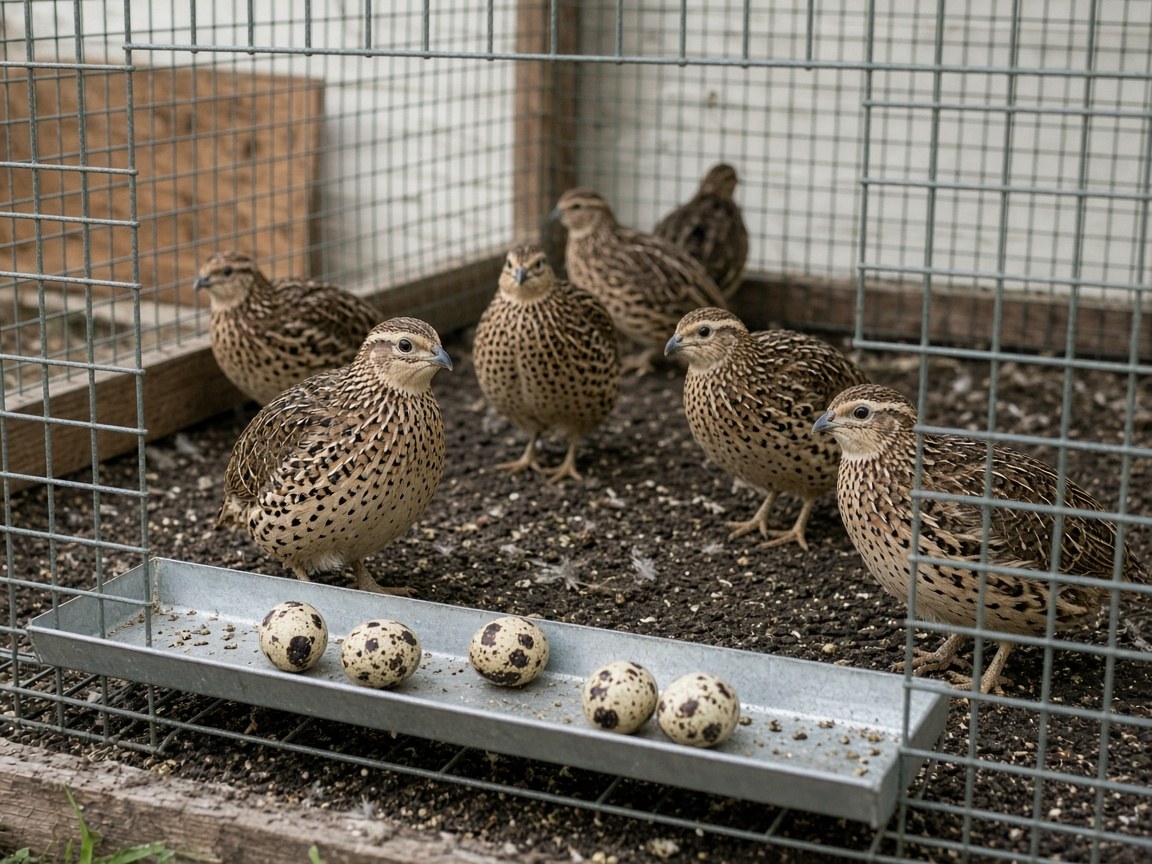
Laying does not require a male
A hen’s ovary releases a yolk on its own cycle. The shell is added whether or not sperm is present. That is why commercial table-egg farms can run hen-only houses, and why a backyard coturnix hen in a cage by herself will still drop eggs (she will just be a lonely, stressed bird — keep a small group, but they can all be hens).
Poultry Extension and NSW DPI describe Japanese quail reaching lay at about 6 to 7 weeks, with NSW citing about 200 eggs in the first year for well-kept hens and full production by about 50 days. Those figures are about hens and management (light, feed, health), not about the presence of a male. Our quail eggs guide and egg production per year article follow the same logic.
What a male does add:
- Fertility, if he is actually mating and is not infertile himself.
- More noise. Males call, especially in the morning. They do not crow like a chicken rooster, but neighbors can still hear them.
- More aggression risk, both toward other males and, if the ratio is wrong, toward hens.
What a male does not add:
- A requirement for the hen to ovulate.
- A guarantee of better shell quality.
- A need, in US food-safety terms, to treat fertile eating eggs differently from infertile ones: both should be handled as eggs. Fertility is not a pasteurization step.
When you should add a male
Add a male only if you want chicks, or if you are selling fertile hatching eggs and have a flock that can legally and honestly be offered that way.
| Your goal | Male needed? | Suggested group |
|---|---|---|
| Eggs for the kitchen | No | 8–12 hens |
| Hatching your own replacements | Yes | 1 male to about 3–5 hens |
| Selling hatching eggs | Yes, plus honest fertility and handling | Same ratio; follow selling rules and any NPIP expectations |
| Pet flock, quiet as possible | Usually no | Hens only |
| Meat grow-out of straight-run chicks | You will have males, but they are not there “so the hens will lay” | Process or separate extra males; they do not improve laying |
Two males in a small pen is a common way to get fighting, scalping and stressed hens. If you need more fertility for a large group of hens, use more than one breeding pen rather than a crowd of males in one box. The ratio math is in the breeding ratio guide, and male-only housing is in whether you can keep male quail together.
How to tell if eggs are fertile without waiting 18 days
You cannot tell by the shell color or by a “rooster present” assumption alone. A male that is too young, too old, injured, outnumbered, or kept too cold or too hot may not be fertile.
- Break-out (for eggs you planned to eat): on the yolk of a fresh fertile egg you may see a small bullseye-like blastoderm; an infertile egg has a denser, irregular white blastodisc. This takes practice and is easier with a fresh egg than with a leftover from the fridge.
- Candling after a week of incubation: developing eggs show veins; clears were infertile or died very early. See how to candle quail eggs.
- Hatch records: the only final test if you are selling hatching eggs.
Store-bought breakfast eggs are usually infertile for this same reason; see will store-bought quail eggs hatch.
Running a hen-only flock well
Hen-only groups still need:
- About 1 square foot per adult, covered in the space guide.
- 14 to 18 hours of light to hold laying, as Poultry Extension recommends for Japanese quail.
- A layer diet once they start, as in when to switch to layer feed.
- More than one hen. A single hen can lay, but coturnix are social.
If a hen-only flock stops laying, the male was not the missing piece. Look at light, age, molt, protein, heat and day length in why quail are not laying eggs.
If you later add a male to a settled hen group, quarantine him first if he is new to the property, then introduce him carefully. A sudden adult male in a tight cage can injure hens.
Fertile vs infertile eggs in the kitchen
A fertile egg that has been kept refrigerated as food and was never incubated is still an egg. It does not contain a developed chick. Once incubation has started, that egg is no longer breakfast. Do not incubate a carton for a week and then eat the clears unless you are sure they smell and look normal; when they have been warm, the safer habit is to discard questionable eggs.
There is no need to keep a male “so the eggs are complete.” If you want eating eggs, skip him.
Troubleshooting
| Problem | Male-related? | What to do |
|---|---|---|
| Hens not laying | Almost never because you lack a male | Check age, light, feed, and health |
| You wanted chicks, all eggs were clear | Yes: no male, infertile male, or wrong ratio and stress | Add or replace a male; improve housing; candle |
| Hens are bald, hiding, or wounded | Often too many males, or not enough space | Remove males; use the 1:3–5 ratio |
| Neighbors complain about calling | Male crows/calls | A hen-only flock is the quiet fix; see quail noises |
| You cannot tell hens from males | Identification, not laying biology | Use male vs female guides, especially on Pharaoh-type birds |
Frequently asked questions
Will hens lay fewer eggs without a male?
Not because of his absence. Production follows light, feed, age, genetics and health. A stressed, over-mated hen with a male may even lay worse.
Can two hens and one male work?
It can, but the male may over-mate a very small group of hens. Three to five hens per male is the more comfortable range for many backyard pens.
Do I need a male for “better” egg taste or nutrition?
Not based on the USDA-style nutrient data used for quail eggs on this site. Taste differences people report are more likely about freshness and the hen’s diet.
How soon can a young male fertilize eggs?
He needs to be sexually mature, which for coturnix is in the same general window as hen maturity, around 6–8 weeks, though fertility is not instant and not guaranteed on the first week of housing him with hens. Give the group time, then candle a test set.
If I remove the male, when do eggs become infertile?
Hens can store sperm for a period and still lay fertile eggs after the male is gone. Do not assume the next day’s egg is infertile. If you must be sure, wait and then confirm with candling or hatch results rather than a single-day guess.
Sources
- Raising Japanese Quail in Small and Backyard Flocks, Jacob and McCrea, Poultry Extension (age at lay; 14–18 hours of light; males and fighting when days are long).
- Randall, M. and Bolla, G. Raising Japanese quail. NSW DPI, via The Poultry Site (laying performance; territorial males).