
Quick answer: How long do quail eggs take to hatch? Coturnix (Japanese) quail eggs usually hatch in 17 to 18 days in a well-run incubator. NSW Department of Primary Industries says the incubation period is 17–18 days, depending on the strain and the incubator. Most chicks pip late on day 16 or 17 and are out by day 18. Give late eggs until about day 19 before you give up, and do not keep opening the hatcher during the hatch. If nothing has happened by day 20, candle leftovers and review temperature, not just the calendar.
How long do quail eggs take to hatch is a short question with a precise answer, and a longer list of reasons a hatch runs early or late. This is not a full incubation manual — that is the how to incubate quail eggs guide, with temperature and humidity in the temperature and humidity chart and the last days in the quail lockdown article. Here the focus is the clock: what “day 1” means, when to expect pipping, when a delay is still normal, and what a very early or very late hatch is trying to tell you.
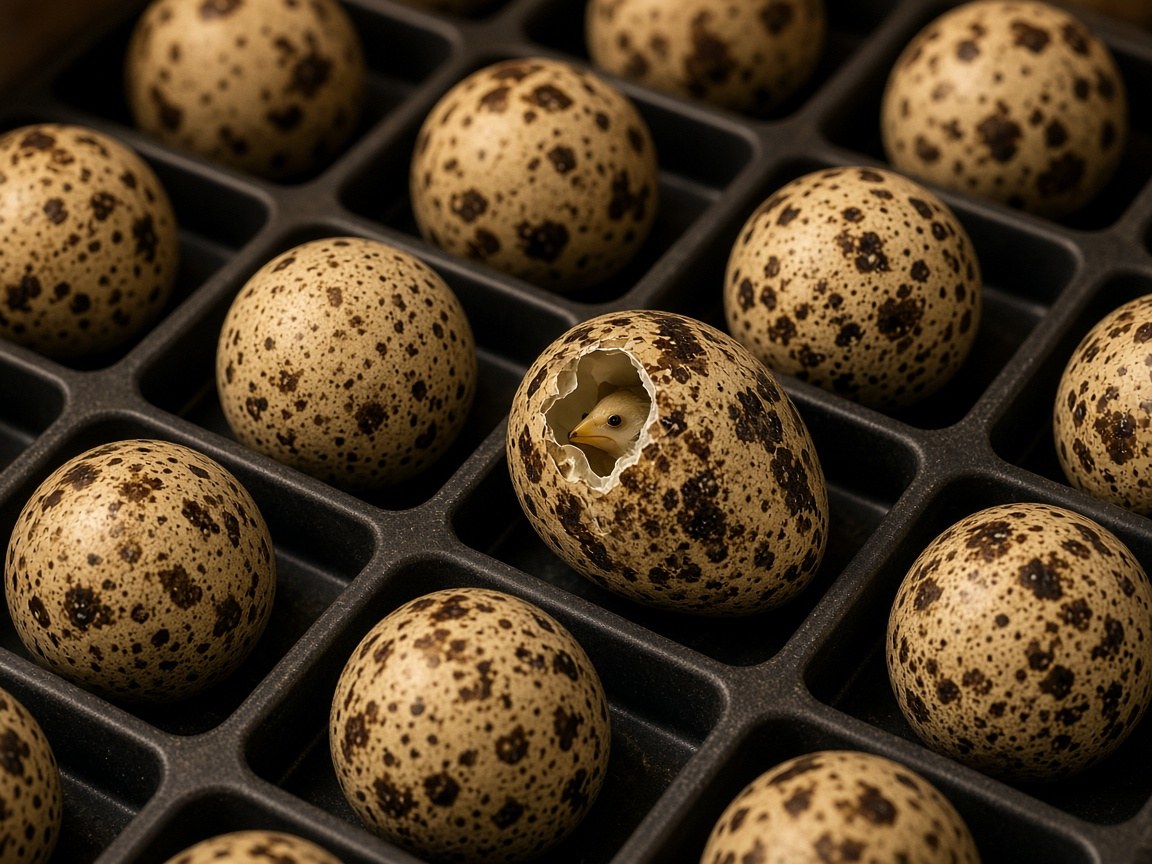
The standard clock: 17 to 18 days
NSW DPI (Randall and Bolla) states that the incubation period for quail is 17–18 days. Poultry Extension and hatchery guidance used by backyard keepers agree on the same window for coturnix. That is much shorter than a chicken egg (21 days) or a bobwhite egg (about 23–24 days). If you are using a mixed-species incubator, do not run coturnix on a chicken schedule.
A typical forced-draft coturnix hatch looks like this when temperature has been steady at about 99.5°F:
| Day | What is usually happening | What you should do |
|---|---|---|
| 0 (set) | Eggs go in, large end up, after they have warmed from storage | Start the count when eggs go into a already-stable incubator |
| 1–14 | Development; turning several times a day | Candle around day 7 if you want to remove clears; see how to candle quail eggs |
| 14–15 | Lockdown for many keepers | Stop turning, raise humidity, and close the incubator |
| 16 | Some early pips in a slightly warm or fast machine | Do not help; leave the lid closed |
| 17 | Many eggs pip and begin to zip | Wait. Chicks can take hours to finish |
| 18 | Most of a healthy hatch is out | Remove dried, fluffy chicks; leave wet ones to finish |
| 19 | A few stragglers | Still wait unless the egg has been pipped for an unusually long, dry stall |
| 20+ | Remaining eggs are usually late-dead or infertile | Candle and stop, then diagnose with why quail eggs are not hatching |
“Day 1” should mean the first full day after the eggs reached incubation temperature. If you set eggs at 10 p.m., do not expect a complete hatch first thing on calendar morning 17 in the same way you would after a 7 a.m. set.
Why some hatches come early or late
Temperature is the main lever. University of Missouri Extension’s incubation guide (G8353) emphasizes that even a small, steady error in temperature changes the timetable and the quality of the chicks. As a rule of thumb used across poultry incubation:
- A little too warm can bring the hatch a day early, with more small, weak or splay-legged chicks and more deaths in the shell.
- A little too cool stretches the hatch past day 18, sometimes with unabsorbed yolk or late deaths.
- Wide swings (a garage incubator that bakes by day and chills at night) produce a messy, drawn-out hatch even when the average looks all right.
Humidity, turning and the age of the eggs matter too. Eggs stored a long time, or shipped, often hatch later and less evenly than fresh farm eggs. Dry incubation can make chicks stick and look “late” when they are actually trapped. Very high humidity can leave oversized, sluggish chicks.
Strain differences are real but usually stay inside the 17–18 day window, not a week off. Jumbo or meat lines still hatch as coturnix, not as chickens.
Pipping, zipping and how long a chick may take to get out
A pip is the first hole in the shell. Zipping is the line the chick makes around the egg. Many healthy coturnix chicks go from pip to out in a few hours; some take longer, especially in a crowded hatcher. Opening the lid to “check” drops humidity and can shrink membranes around half-out chicks. NSW DPI says the hatcher should not be opened during the hatching process, and that if procedures were followed, chicks may be removed on the 17th or 18th day.
Helping is rarely the right first move. A chick that has been pipped for a long time with a dry, tightened membrane is a different situation than a chick that pipped 90 minutes ago and is resting. If you ever assist, it should be as a last step after humidity and patience, and with the risk that a chick not ready to come out may bleed from an unused blood vessel.
Still-air vs forced-draft timing
NSW DPI gives slightly different operating temperatures for still-air machines, which run hotter on the thermometer because heat layers in the box (it describes 38.3°C / 101°F in week one and 38.8°C / 102°F in week two in a still-air incubator). The hatch is still expected in 17 or 18 days, not a different species-length. If your still-air hatch is always late, the thermometer is often in the wrong place or the box is running cooler than you think. Measure at egg height.
A late hatch checklist
Before you throw out day-18 eggs:
- Confirm the set date and whether the incubator was truly at temperature on night one.
- Look through the window: are there pips you missed?
- Wait through day 19 if there is movement or pipping.
- Candle remaining eggs on day 19 or 20. A dark, still egg with a bad smell is done. An egg with a living embryo may still be worth a few more hours, but not an open-ended week.
- Write down whether the group was early, on time, late or spread over many days. That is a temperature and storage clue for the next batch.
Troubleshooting
| What you see | Likely timing issue | What to change next time |
|---|---|---|
| Hatch mostly on day 16, weak or splayed chicks | Incubator too warm | Recalibrate the thermometer; confirm 99.5°F in a forced-draft machine |
| Hatch starting day 19 or 20, some unhealed navels | Too cool, or eggs were stored a long time | Raise and stabilize temperature; set fresher eggs |
| A 3-day dribble of chicks | Temperature swings, mixed egg ages, or lid opened often | Run the machine in a steady room; set eggs of similar age; stay out during lockdown |
| Lots of pips, few chicks out | Humidity too low in lockdown, or you opened the hatcher | Follow the lockdown humidity steps; resist peeking |
| Nothing by day 18, all clear on the candle | Infertile or very early death | Review breeders, storage and whether the eggs were ever fertile, not the hatch day |
Frequently asked questions
Do jumbo quail eggs take longer to hatch?
Usually not in any way you should plan around. Keep the same 17–18 day schedule and judge by pipping, not by the word “jumbo” on the listing.
Can I hatch coturnix under a broody chicken?
NSW DPI says Japanese quail hens rarely go broody, but eggs can be set under a broody hen, with bantams a good fit, and any chicken eggs removed so the group hatches together. The chicks will still emerge on a quail clock, about a week before chicken eggs would. Be ready to brood them earlier.
What if only one egg is late?
Leave it through day 19 if it is not obviously dead or smelling. A single late chick is common. A whole incubator of late eggs is a machine or storage problem.
Should I start the countdown when the hen laid the egg?
No. Storage time is not incubation time. Holding days are covered in how long quail eggs can sit before incubating. The hatch clock starts when the egg is warmed in the incubator.
Why did store-bought eggs do nothing on day 18?
Most grocery quail eggs are not fertile, or they have been washed and refrigerated. See will store-bought quail eggs hatch.
Sources
- Randall, M. and Bolla, G. Raising Japanese quail. NSW DPI, via The Poultry Site (17–18 day period; still-air temperatures; do not open the hatcher; chicks removable on day 17 or 18; natural incubation under a bantam).
- Lyons, J. J. Small Flock Series: Incubation of Poultry (G8353). University of Missouri Extension (temperature as a critical control).
- Raising Japanese Quail in Small and Backyard Flocks, Jacob and McCrea, Poultry Extension.