
Quick answer: Do quail need grit? They need insoluble grit only if they eat whole grains, seeds or forage. Coturnix on a complete crumble or mash in a cage can grind that feed without a grit hopper, because the feed is already processed. Laying hens still need calcium, usually from a layer diet and free-choice oyster shell, which is not the same as grit. If birds free-range in a covered run or get scratch and bugs, offer a small dish of appropriately sized insoluble grit and let them take it.
Do quail need grit is two questions that get mixed together: do they need hard stones to grind food in the gizzard, and do they need extra calcium for eggshells? The answers are different. This guide separates insoluble grit (granite or flint-type stones) from soluble grit (oyster shell or limestone), explains when a backyard coturnix flock actually uses each, what size to buy, and what goes wrong when keepers pour hen-sized grit or oyster shell into a chick brooder. For the rest of the diet, see what do quail eat and what can quail eat.
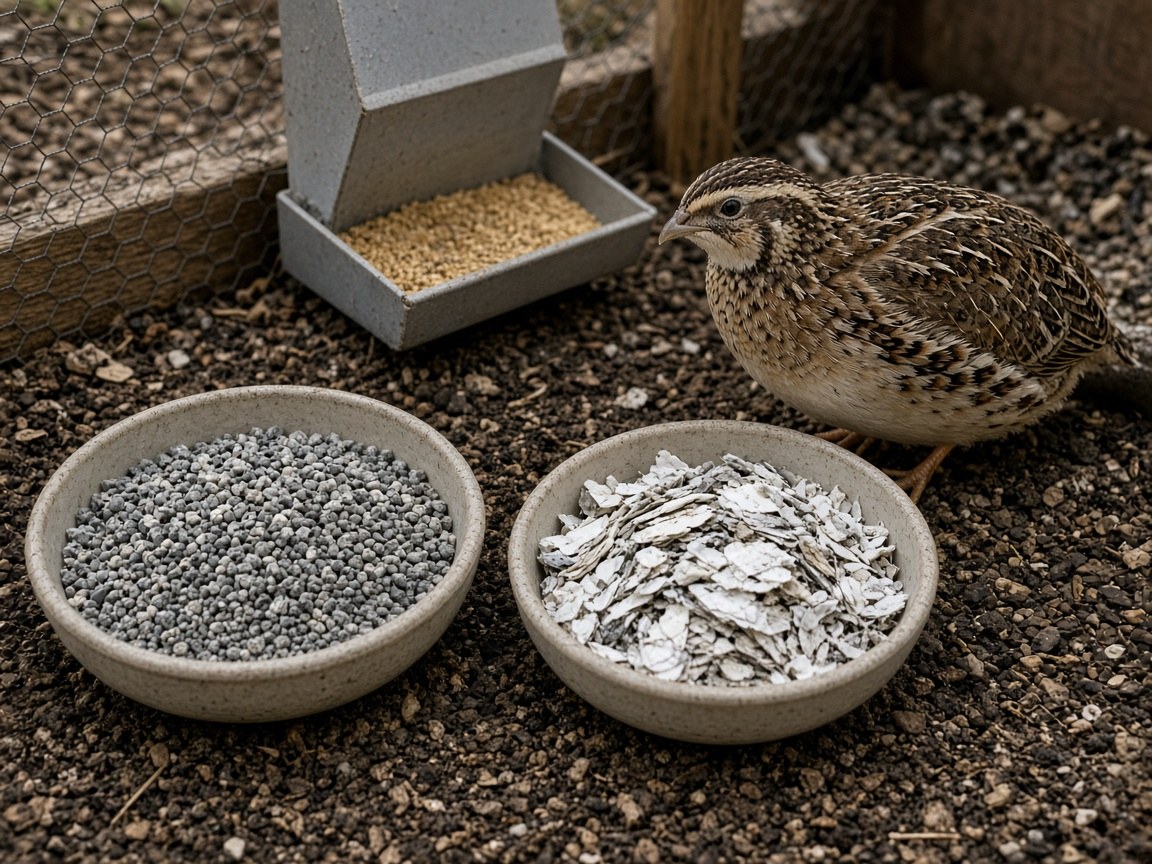
Insoluble grit vs oyster shell
| Product | What it is | What it does | Who needs it |
|---|---|---|---|
| Insoluble grit (granite, flint, or “true” grit) | Hard stone that stays in the gizzard | Helps grind whole seeds, insects with tough parts, and fibrous forage | Birds that eat more than a fine complete feed |
| Soluble “grit” / oyster shell / coarse limestone | Calcium carbonate that dissolves | Supplies calcium for eggshells and bone | Laying hens, as a supplement to a layer diet |
| Chick grit | A finer insoluble grit | Same grinding job, in a smaller particle | Only if chicks are offered whole seeds or coarse treats, which they usually should not be in week one |
NSW DPI says shell grit or ground limestone can be added to the diet after 5 weeks of age, or provided separately as free choice, because calcium and phosphorus must rise as birds near maturity. That sentence is about calcium, not about granite grit. The same bulletin mentions increasing dietary fiber and grit as one way to limit pecking, which is a husbandry note, not a requirement to top-dress an already complete crumble.
If a bag is labeled only “grit,” read whether it is granite or oyster shell. The wrong one in the wrong dish is the most common mistake on this topic.
When cage-fed coturnix do not need a grit hopper
A complete game bird or turkey crumble or mash has already been ground and balanced. The gizzard still works, but it is not being asked to smash whole millet and cracked corn all day. Many extension feeding programs for small flocks are built on complete feeds for that reason.
You can skip a dedicated insoluble-grit dish when:
- The only food is a complete crumble, pellet (eaten as pellets or crushed), or mash.
- Birds are in a wire or solid-floor cage with no access to soil, whole seeds or coarse forage.
- Treats are soft or tiny (a little chopped green, a few mealworms) and stay a small part of the diet.
You should offer insoluble grit when:
- Birds get scratch, whole millet, black oil seeds, or mixed grains.
- They spend time on soil or in a covered run and peck up seeds, grit from the ground, or fibrous plants.
- You feed any homemade grain mix. (A complete commercial diet is still the safer staple.)
If they have access to coarse, clean sand in a dry run, they may pick up some grit themselves. That is not a reason to dump a pile of large chicken grit into a water bowl.
Size, amount and how to offer it
Use a particle the birds can swallow comfortably. Chick or “game bird” grit is a better starting size than chunky hen grit meant for large chickens. A little goes a long way.
- Put insoluble grit in a separate small dish, not mixed by the handful into a whole bag of feed, so birds can take what they need.
- Keep it dry and clean. Do not let it cake with droppings.
- For oyster shell, also use a separate dish, and offer it once hens are at or near lay, alongside the switch described in when to switch quail to layer feed.
- Do not force either product as the only “feed” in front of a hungry bird.
Free choice is the usual method: the dish stays available, and you refill when it is low. You are not aiming to make them eat a daily spoonful.
Chicks, grit and dangerous mix-ups
Day-old coturnix on starter crumble do not need a mound of grit, and they do not need oyster shell. Extra calcium that early is for layers, not for chicks on a 1% calcium starter (the NSW starter figure). A few grains of very fine chick grit are unlikely to matter if they are exploring, but a dish of coarse hen grit or oyster shell in a brooder is the wrong hardware.
Wait until birds are on more than a fine mash, or until pullets are approaching lay for oyster shell. [[What do baby quail eat|What baby quail eat]] covers the starter diet itself.
What if they eat too much grit, or none?
True grit impaction from a reasonable free-choice dish is uncommon in coturnix that also have a complete feed and water. Problems are more often:
- Birds filling up on large grit or shell because feed is short.
- Wet, dirty grit that grows mold.
- No calcium source for layers, which shows up as thin or soft shells, not as a “grit deficiency.”
- Using sandy, dusty material as the only floor and also as the only grit, until it is filthy.
If layers produce weak shells, add a proper laying diet and oyster shell, and check vitamin D and heat stress, rather than pouring more granite grit into the pen. Granite will not build an eggshell.
Troubleshooting
| Problem | Is grit the issue? | What to do |
|---|---|---|
| Soft or thin eggshells | Not insoluble grit; it is calcium, diet, or health | Switch to a layer feed, offer oyster shell, review laying problems |
| Birds eat whole millet and pass whole seeds | Possibly not enough insoluble grit | Offer a small dish of fine insoluble grit |
| Chicks in a brooder with a dish of oyster shell | Wrong product, wrong age | Remove it; keep them on starter |
| Birds are on crumble only and ignore the grit dish | Normal | You can put it away until you feed whole seeds or they go on soil |
| Gizzard or crop issues after a big scratch treat | Too much whole grain at once, or no grit for that treat | Cut scratch; add appropriate grit; make complete feed the staple |
Frequently asked questions
Do quail need grit if they are on pellets?
If they swallow pellets whole, a little insoluble grit can help them grind the pieces, but a complete pellet is still a processed feed. Many flocks do fine without a grit hopper if pellets are a comfortable size or are crushed, and if they get no whole grains. Watch droppings for undigested pellets.
Can they use playground sand or dirt?
Clean, coarse sand can provide some grit. Playground sand is sometimes very fine and dusty, and outdoor dirt may be soiled with droppings. A purchased chick or game-bird grit is more predictable.
Is limestone grit the same as oyster shell?
Both can supply calcium if they are meant to dissolve. They are not a substitute for granite grit. Check the label.
Do I still need grit if I also feed mealworms?
Dried mealworms are a treat, not a reason by themselves to run a large grit program. If treats include whole seeds, offer grit. Keep treats limited.
Can lack of grit cause sour crop or pasty vent?
Pasty vent in chicks is more often about heat and diet texture. Crop problems have several causes. Grit is not the first or only fix; look at feed, water, and whether the bird can actually grind the foods you offered.
Sources
- Randall, M. and Bolla, G. Raising Japanese quail. NSW DPI, via The Poultry Site (shell grit or limestone after 5 weeks as calcium; grit mentioned among pecking-prevention measures).
- Alabama Cooperative Extension System. Feeding Game Birds (ANR-1343) (complete diets by life stage; calcium differences in layer/breeder feeds).
- Raising Japanese Quail in Small and Backyard Flocks, Jacob and McCrea, Poultry Extension.