
Quick answer: How to clean a quail cage well is a short daily reset plus a deeper weekly wash, with the real target being dry droppings and low ammonia, not a pretty cage. Scoop or swap trays every day, keep drinkers from soaking the litter, and scrub, rinse and dry the cage on a schedule before you smell ammonia. Poultry guidelines recommend keeping ammonia below 25 ppm; most people cannot smell it until about 20 to 30 ppm, so if you can smell it, the birds have already been breathing too much.
How to clean a quail cage and control ammonia matters more for coturnix than the size of the coop. If you have been searching how to clean quail cage setups that still smell after a rinse, the missing piece is usually moisture, not a stronger soap. These birds live close to their droppings, especially in stacked cages and solid-floor hutches, and wet manure releases ammonia that burns eyes and airways. Penn State Extension notes that the human nose often misses ammonia until 20 to 30 ppm, while poultry health guidance is to stay below 25 ppm. This guide gives a practical daily, weekly and deep-clean routine, a safe disinfectant approach, and fixes for cages that still smell after you scrub.
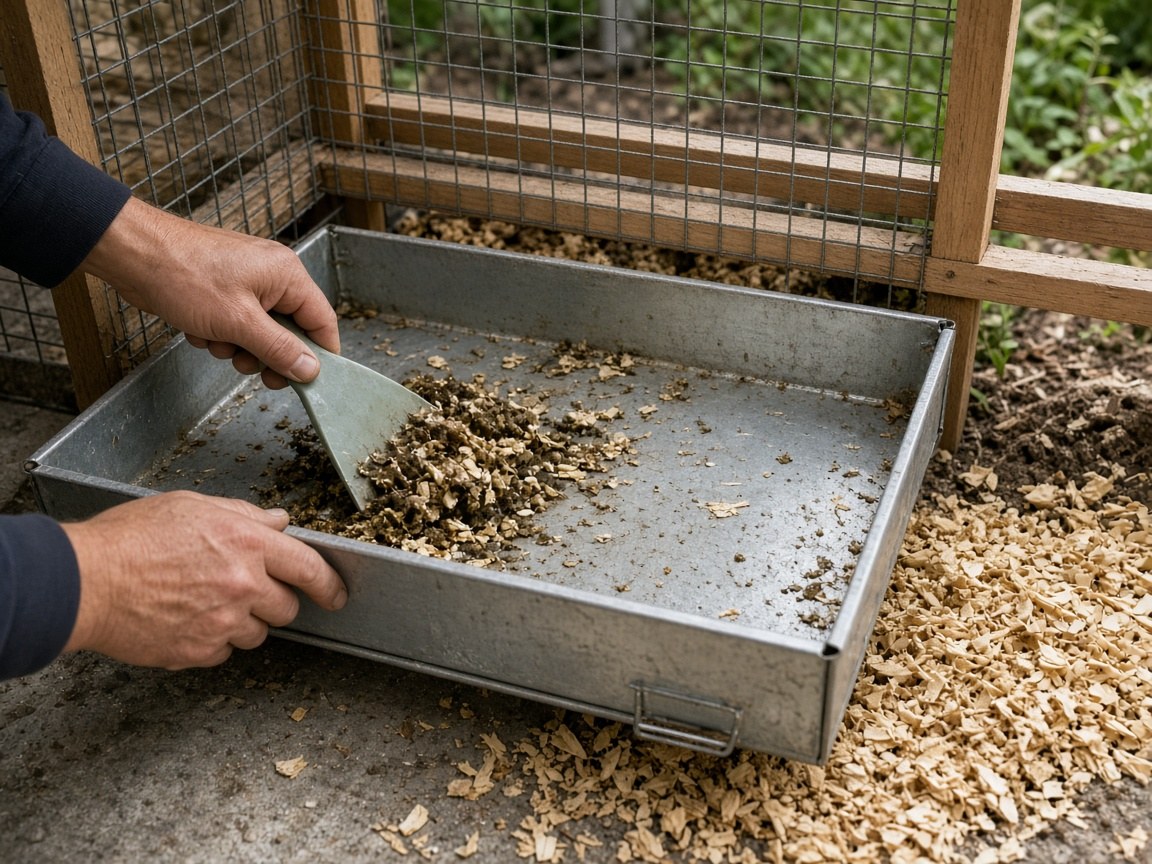
Why ammonia builds up so fast in quail cages
Ammonia forms when bacteria break down uric acid in droppings. Two things speed that up: moisture and warmth. A leaking nipple, a bath splash, overnight humidity or a tray you did not dump will turn a manageable day’s droppings into a sharp, eye-watering smell.
In a small backyard cage the birds cannot move away from the air the way a chicken can in a large house. Respiratory irritation then shows up as watery eyes, sitting puffed, or the kind of breathing trouble covered in the quail respiratory infection guide. Wet, dirty floors also raise the risk of bumblefoot and dirty eggs.
A clean cage is mostly a dry cage. Disinfectant cannot make up for a tray that stays wet.
A cleaning schedule that actually fits a small flock
Match the routine to the housing. Wire cages with pull-out trays are the easiest. Solid-floor pens need litter changes, not just a scrape.
| Task | How often | What “done” looks like |
|---|---|---|
| Dump or scrape droppings trays | Daily, twice a day if the cage is crowded or the weather is humid | Tray is empty and not slick |
| Refresh wet spots in litter | Daily | No clumps, no dark wet rings under drinkers |
| Refill and wipe drinkers and feeders | Daily | Water is clear; no film or feed slime |
| Swap or stir litter / replace cage liners | Every 2–7 days, sooner if wet | Dry, low odor, birds have clean feet |
| Wash trays, grates and catch boards with soap and water | Weekly | No baked-on crust |
| Full cage empty-out, scrub, rinse, dry, disinfect | Every 4–8 weeks, or between flocks | Cage is dry before birds go back |
| Clean dust-bath tub | Weekly, and whenever it is damp or soiled | Loose, dry dust; see quail dust bath |
Daily work for a single cage is usually 5 to 10 minutes. Putting it off until “the weekend” is how ammonia spikes.
How to clean a quail cage, step by step
Daily reset
- Move the birds only if you must. Many tray-style cages can be scraped without catching every bird.
- Remove leftover perishable treats and wet feed.
- Dump the tray or bag the soiled litter. Do not leave a full tray sitting in the sun beside the cage; flies will find it.
- Scrape crust from corners and from under the feeder.
- Wipe the waterer. Biofilm on a drinker is a daily problem, not a monthly one.
- Put down a thin fresh layer of litter or a clean liner if you use one.
- Check that the tray actually seats well so droppings do not fall behind it.
Weekly wash
- Take out trays, feeders, waterers and any wooden hides.
- Scrape first. Soap on top of a thick crust just makes mud.
- Wash with hot water and a mild detergent. A plastic scraper and a stiff brush beat a pressure washer in a small setup, and they will not drive dirty water into the next cage.
- Rinse until the surface is not slippery with soap.
- Let metal and plastic dry. Disinfectant on a dripping cage is wasted.
- Apply a disinfectant that lists poultry or farm use, following the label contact time. Rinse if the label says to.
- Dry again, then reassemble and only then return any birds you removed.
Do not mix bleach with ammonia, vinegar or other cleaners. If you use household bleach on a washed, rinsed surface, follow a fresh dilution and never use it in a poorly ventilated room with the birds still inside.
Deep clean between groups
Empty the cage completely. Replace chewed wood, rusty trays and cracked plastic. Wash the stand, the wall behind a balcony cage and the floor under it. Mice and flies live in the “almost clean” zone around the cage, not only in the tray.
If you compost the manure, use the method in quail manure as fertilizer. Fresh droppings are too hot and too messy to spread straight on vegetables you will eat soon.
Litter and liners: what helps ammonia, what does not
The quail bedding guide compares materials. For cleaning and ammonia, the rules are simpler:
- Pine shavings, pelleted bedding or a sand layer can work if you keep them dry and do not let them pack into a wet cake.
- Slick newspapers alone get wet fast and smell early, though they are easy to roll up on a tray.
- Deep, always-wet litter is the worst case in a solid-floor pen.
- Wire floors with a tray underneath stay cleaner at bird level if the mesh is comfortable for feet and you dump the tray often.
A thin layer changed often beats a deep layer that hides moisture. If you can wring liquid from a handful of litter, it is past due.
How to tell the air is actually okay
You should not wait for a burning nose. Penn State Extension points out that people who spend time around poultry housing get used to the smell and can miss even high levels, and that a casual visitor may stop noticing an odor in about 20 minutes.
Practical checks in a backyard cage:
- Stand at bird height, not standing tall above the cage, after the pen has been closed a while.
- If your eyes water or you smell a sharp urine-like odor, ventilate and clean immediately.
- Look at the birds: watery eyes, sitting around with open-mouth breathing, or dirty, wet vents are a sign to fix air and moisture today, not next week.
- A cheap ammonia test strip or a handheld meter is useful in a garage or poorly vented shed. In an open outdoor hutch, moisture and dirty trays are still the main problem.
Ventilation is part of cleaning. A plastic tote “cage” with a lid, or a winter coop sealed against drafts, will hold ammonia even when the tray is only moderately dirty. Swap air without putting the birds in a direct cold draft.
Troubleshooting a cage that still smells
| Problem | Likely cause | Fix |
|---|---|---|
| Smell returns within hours of cleaning | Drinker leak, bath splash, or too many birds | Raise or move the waterer; cut bath time to a supervised dish; check stocking in the space guide |
| Ammonia in winter | Closed windows, wet litter, less ventilation | Vent at the top; add dry bedding more often; never heat a tightly sealed box |
| Flies | Open manure pile, dirty tray left beside the cage | Dump into a closed bin; wash trays weekly; move compost away from the pen |
| Rusty, crusted wire | Skipped deep cleans, wet metal | Wire-brush, replace failed trays, dry thoroughly |
| Dirty eggs | Birds walking in droppings, or a solid floor with hidden eggs | Collect more often; consider a roll-out tray; keep the floor dry |
| Birds cough or wheeze after you “smell nothing” | You have adapted to the odor | Ask someone else to sniff, or test; treat the air as unsafe until it is drier and fresher |
Frequently asked questions
Can I use pine-sol, essential oils or scented sprays to hide ammonia?
No. Covering the smell does not lower the gas the birds are breathing, and many household fragrances are a poor idea around poultry. Clean, dry and ventilate instead.
How often should I change sand in a sand-floor cage?
Spot-clean wet and soiled sand every day and replace it when it stays damp, cakes or smells, which may be weekly in a small cage. Sand that looks “mostly clean” can still hold urine at the bottom.
Is a hose-down good enough?
A hard spray without scraping leaves a film of organic matter, and disinfectant cannot work through that film. Scrape, wash, rinse, dry, then disinfect.
Can I clean with the birds still in the cage?
Daily tray dumps, yes, if you can do it calmly. For detergents, bleach solutions or any strong fumes, move the birds to a safe spare pen and wait until surfaces are dry and the air is clear.
What do I do with the dirty litter?
Bag it for trash where that is required, or compost it until it is finished. Do not dump fresh quail manure against the house foundation or into a vegetable row. Details are in the manure guide linked above.
Sources
- Penn State Extension. Detecting Ammonia in Poultry Housing Using Inexpensive Instruments (odor threshold about 20–30 ppm; keep ammonia below 25 ppm).
- Mississippi State University Extension. Poultry Litter Management (ventilation and the limits of relying on your nose).
- Randall, M. and Bolla, G. Raising Japanese quail. NSW DPI, via The Poultry Site (housing should allow easy, effective sanitation).