
Quick answer: Will store-bought quail eggs hatch? Almost always no. Grocery and most restaurant-supply quail eggs are sold as food, not as hatching stock. They are typically from hen-only barns (so they were never fertile), washed, and held at refrigerator temperatures around 40°F, which is far colder than the 55–65°F range used for holding hatching eggs. Even a fertile table egg that has been chilled, delayed and handled as food has a poor chance in an incubator. If you want chicks, buy eggs sold as fertile hatching eggs from a breeder or hatchery.
Will store bought quail eggs hatch is a fair question, because the eggs in the carton look just like the ones a hobby incubator is designed for. The difference is not the spots on the shell. It is fertility, washing, storage temperature and time. This guide explains why a supermarket carton is the wrong starting point, how to tell a hatching egg from a table egg before you buy, what happens if you try anyway, and a more reliable path to a first hatch. For the incubation process itself, use how to incubate quail eggs.
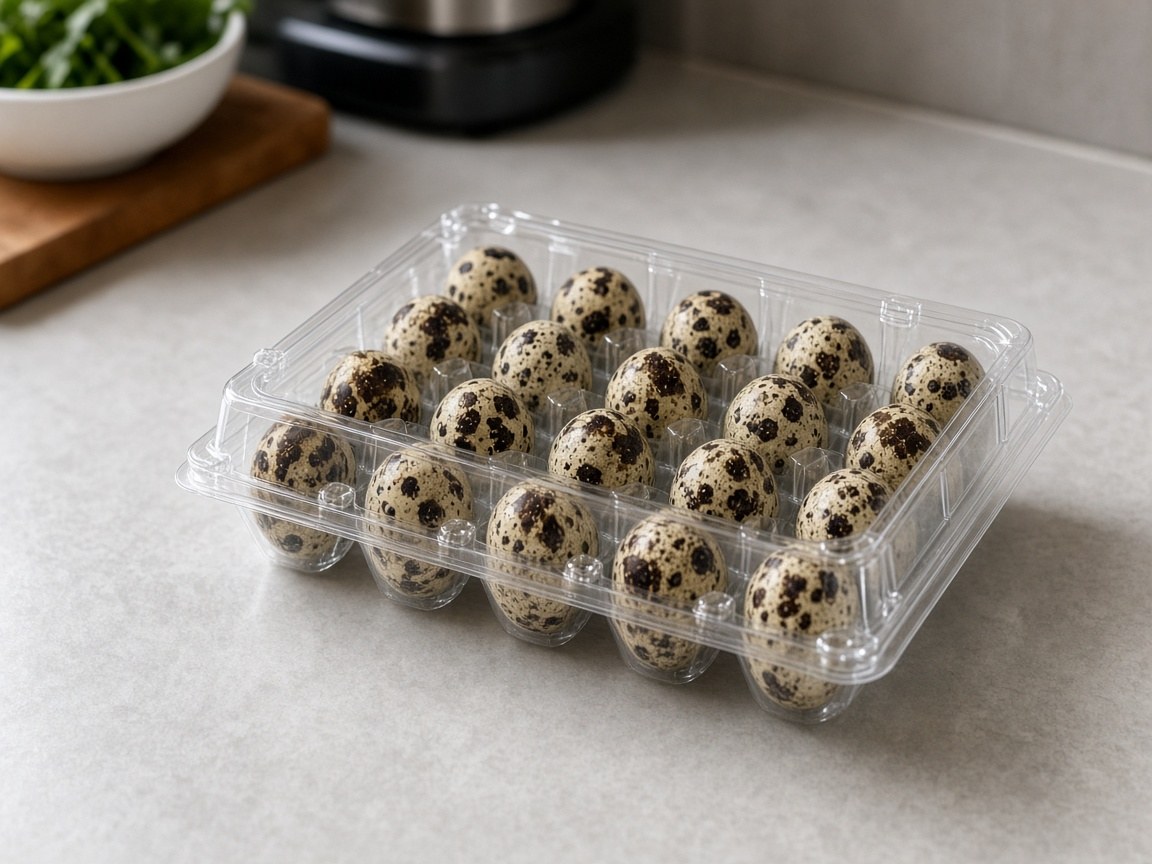
Three reasons table eggs usually cannot hatch
1. They were probably never fertile
A hen lays eggs whether or not a male is present. That is the whole point of whether quail need a rooster to lay eggs: you do not need a male for breakfast eggs, and commercial egg farms generally do not keep males with laying hens. An unfertilized egg will never develop a chick, no matter how carefully you set the incubator.
A farmer’s-market carton labeled only “fresh quail eggs” is still usually a table egg. Unless the seller can tell you the eggs are from a flock with males, and that they were handled as hatching eggs, assume they are food.
2. They have been washed
US table eggs are commonly washed and then must be kept cold. Washing removes much of the bloom (cuticle), the natural coating that helps keep bacteria out. University of Missouri Extension (G8353) and other incubation guides tell small-flock keepers not to wash hatching eggs for that reason. A washed grocery egg is prepared for the frying pan and the refrigerator, not for a warm, humid incubator, where bacteria have an easier path through a stripped shell.
3. They have been refrigerated and held too long
FDA advice for eating eggs is to refrigerate promptly at 40°F or below. That is good food safety. It is the opposite of hatching-egg storage. Penn State guidance, published via AgMRC for bobwhite production and widely used for holding game-bird eggs, is 55–65°F, with eggs ideally set within 3–7 days, and hatchability dropping when eggs are held longer than about 7–10 days. A household refrigerator is too cold, and a grocery egg may already be more than a week from the lay date when you buy it.
Cold plus age plus, sometimes, rough transport is why even a secretly fertile carton usually produces clears, early deaths or a bad smell, not a brooder full of chicks.
How to tell table eggs from hatching eggs before you spend money
| Clue | Table / store eggs | Hatching eggs |
|---|---|---|
| How they are sold | Grocery, food co-op, restaurant pack, “for eating” | Hatchery, breeder, farm listing that says fertile hatching eggs |
| Flock | Often hen-only; seller may not know | Seller should describe the breeding group and ratio |
| Storage | Refrigerated at about 40°F | Cool, not cold, often 55–65°F, unwashed |
| Washing | Common for US retail cartons | Should be dry-cleaned only, not washed |
| Age | Pack date may be many days after lay; you rarely get the lay date | You want lay dates, or at least a packed-this-week promise |
| Price and shipping | Food price; no incubator instructions | Often higher; shipped with a rest period after arrival |
| Legal label | Food product, sometimes graded | Sold as livestock hatching eggs, not as a breakfast staple |
Pasteurized or “already cooked in the shell” eggs will not hatch. If a carton touts a process that kills Salmonella with heat, that process also kills any embryo.
What if you already put grocery eggs in the incubator?
You can candle them around day 7 with a bright light, as in the candling guide. The honest expectation is a clear egg (even glow, yolk shadow, no spider veins). If every egg is clear, stop and discard them as the food they were, or cook any that still smell normal and have been handled cleanly — but do not eat eggs that have sat in a warm incubator for a week if they smell off or are cracked. When in doubt, throw them out.
If you did see veins in a grocery egg, you found a rare fertile table egg. You can continue, but hatch rates from refrigerated, washed eggs are still often poor. Do not plan housing or a brooder around that hope.
What to buy instead
- Fertile hatching eggs from an NPIP-participating flock when you can, especially if you also care about disease status. See NPIP certification for quail.
- Day-old chicks if you do not want to run an incubator yet.
- Adult or started hens if you want eggs to eat, not a hatch.
If you buy shipped hatching eggs, let them rest, pointy end down, at room temperature for about 24 hours before setting, which is the usual hatchery advice (Meyer Hatchery and others). Then incubate them as hatching eggs, not as a science project on a grocery carton.
Selling leftover table eggs from your own hens is a food question, covered in selling quail eggs. Those eggs, once washed and refrigerated, should also be treated as food, not as a second incubator batch.
A cleaner experiment if you just want to see a hatch
Use eggs from a flock that definitely has a male, collected clean, stored cool for only a few days, and never washed. That experiment answers “can I hatch a quail egg?” A supermarket carton answers a different question: “can I reverse food storage?” Usually you cannot.
Troubleshooting
| What happened | Meaning | Next step |
|---|---|---|
| All grocery eggs clear at day 7 | Almost certainly infertile or never developed | Stop; buy fertile hatching eggs or chicks |
| A few early blood rings | There may have been fertility, then cold storage or age killed development | Same; do not repeat with another food carton |
| Eggs sweat, mold or explode | Washed shells, condensation, or already old eggs in a warm, wet box | Discard sealed in a bag; clean the incubator |
| You cannot find “fertile” eggs locally | Common in some regions | Order chicks, or buy hatching eggs from a reputable shipper and rest them on arrival |
Frequently asked questions
What if the grocery eggs were on a room-temperature shelf?
In the United States, retail shell eggs are generally expected to be refrigerated. A carton left warm in a store is a food-safety problem, not a better hatching opportunity.
Can I hatch quail eggs from a restaurant or Asian market?
Same rule: if they were sold as food and kept as food, do not expect a hatch. Packaging in a different language does not change fertility or storage.
Do “organic” or “pasture-raised” quail eggs hatch better?
Those labels are about how the birds were kept for food production. They do not mean a male was present or that the eggs were stored as hatching eggs.
Could I ask a store for unwashed, unrefrigerated eggs?
Retail food rules make that unlikely in a US supermarket. A local breeder is the right place to ask for unwashed fertile eggs.
If store eggs will not hatch, why do people say they tried?
Some people have put cartons in incubators and gotten nothing, then told the story as a warning. A very small number may have gotten a fertile carton by chance. It is not a method you can count on, and it is a poor use of a month of incubator time.
Sources
- U.S. Food and Drug Administration. What You Need to Know About Egg Safety (refrigerate at 40°F or below; table-egg handling).
- Penn State Cooperative Extension, via AgMRC. Bobwhite Quail Production (hold hatching eggs at 55–65°F; set within 3–7 days; hatchability drops after about 7–10 days).
- Lyons, J. J. Small Flock Series: Incubation of Poultry (G8353). University of Missouri Extension (do not wash hatching eggs).
- Raising Japanese Quail in Small and Backyard Flocks, Jacob and McCrea, Poultry Extension.