
Quick answer: Celadon quail are ordinary coturnix (Japanese quail) that carry two copies of a recessive gene, ce, which makes hens lay pale blue to blue-green eggs. It is an egg trait, not a breed or a feather color, so you cannot spot a celadon bird by looking at it. Ito and colleagues described the gene in 1993. To get a flock where every hen lays blue eggs, breed only birds that are ce/ce on both sides: a celadon hen mated to an ordinary male gives daughters who lay normal speckled eggs. Care, feed and incubation are the same as for any coturnix.
Celadon quail are the reason many keepers get into coturnix in the first place: a carton of small, sky-blue eggs is hard to forget. The catch is that the blue color is hidden in the genes, and a lot of people buy “celadon” hatching eggs and end up with hens that lay plain brown ones. This guide explains what the celadon gene actually does, what the science says about the eggs, how to breed a line that lays true, and what to check before you pay a premium.

What a celadon quail is (and is not)
A celadon quail is a Japanese quail, Coturnix japonica, that lays celadon-colored eggs. The name describes the egg, not the bird.
- It is not a separate breed. There is no registry or breed standard for celadon. Any feather color can carry it: Pharaoh, tuxedo, Italian, white and so on. Our guide to coturnix quail breeds explains how feather colors and size lines work.
- It is not visible on the bird. Celadon birds look exactly like other coturnix of the same color. You only see the trait when a hen starts laying.
- It is not the same as a white egg. Some coturnix lines lay plain white eggs, which is a different gene (more on that below).
- It does not change care. Housing, feed, light and lifespan are the same as for any coturnix. Start with our beginner’s guide to raising coturnix quail if you are new.
The science behind the blue egg
The trait was first described by Ito, Tsudzuki, Komori and Mizutani in the Journal of Heredity in 1993. They found it was controlled by an autosomal recessive gene, which they named ce (celadon). OMIA, the University of Sydney’s database of inherited traits in animals, still lists it that way.
Their pigment analysis explains the color. A normal quail eggshell carries two pigments: protoporphyrin, the brown that makes the speckles and blotches, and biliverdin, a blue-green pigment. In celadon shells the protoporphyrin content was much lower than in normal shells, and biliverdin was about 44% of the normal level. With most of the brown gone, the remaining blue-green shows through.
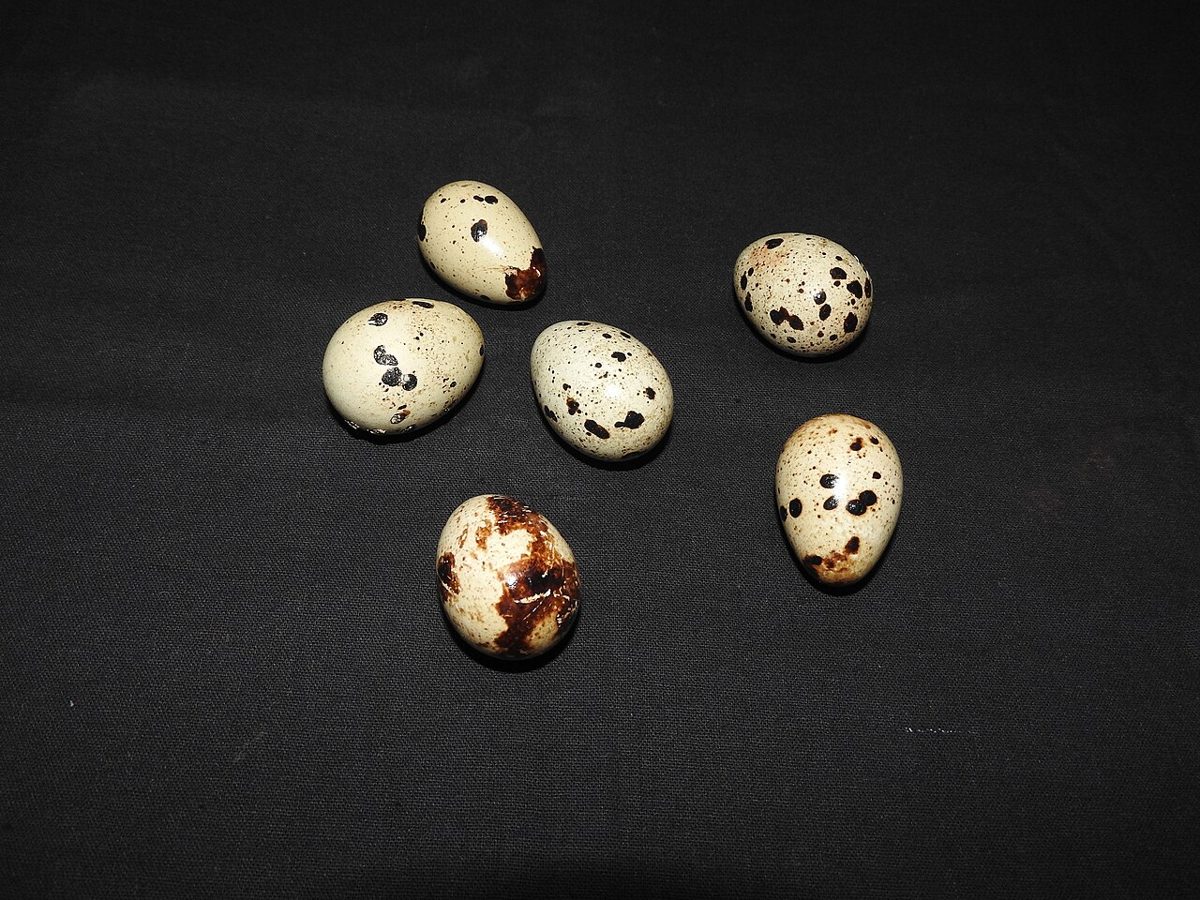
NSW Department of Primary Industries notes that normal Japanese quail eggs are mottled brown and often covered with a light blue, chalky material, and that each hen tends to lay her own characteristic pattern. That is why the shade of celadon eggs also varies from hen to hen.
| Egg type | What you see | Cause | Source |
|---|---|---|---|
| Normal (wild type) | Cream to tan with brown speckles or blotches, often a chalky bloom | Protoporphyrin plus biliverdin | Ito et al. 1993; NSW DPI |
| Celadon | Pale blue, aqua or blue-green; some hens add light speckling | Two copies of the recessive ce gene; much less protoporphyrin | Ito et al. 1993 |
| White eggshell | Plain white or off-white | A different recessive gene, we | Ito et al. 1993 |
Are celadon eggs weaker or worse to eat?
Not according to the one detailed study we found. Damaziak and colleagues (British Poultry Science, 2026) compared celadon eggs with wild-type eggs from Jumbo, Pharaoh and Texas quail groups, both fresh and after 28 days at 4°C (39°F).
- Celadon shells had more pores, but each pore was smaller.
- There was no difference in shell strength between celadon and wild-type pigmented eggs.
- Overall egg quality was similar, and celadon eggs stored just as well.
So the blue color is cosmetic. Nutrition comes from what is inside the shell, and there is no evidence that celadon eggs differ there. Store and cook them like any quail egg; our quail eggs guide covers collecting and storage.
How celadon inheritance works
Every quail has two copies of the gene, one from each parent. Write the celadon version as ce and the normal version as +.
| Bird’s genes | Hen’s egg color | What she or he passes on |
|---|---|---|
| ce/ce | Celadon (blue) | Always ce |
| ce/+ (carrier) | Normal speckled | ce to half her chicks, + to the other half |
| +/+ | Normal speckled | Always + |
Males have the same genes but never show them, because males do not lay. That is the single biggest source of confusion in celadon breeding: a hen tells you her genes with every egg, but a male can only be judged by his parents and his daughters.
What each pairing produces
| Male × hen | Daughters that lay blue eggs | The rest |
|---|---|---|
| ce/ce × ce/ce | 100% | None |
| ce/ce × ce/+ | About 50% | About 50% carriers |
| ce/+ × ce/ce | About 50% | About 50% carriers |
| ce/+ × ce/+ | About 25% | About 50% carriers, 25% non-carriers |
| +/+ × ce/ce | 0% | All carriers |
| ce/ce × +/+ | 0% | All carriers |
These percentages follow from simple recessive inheritance, the mode Ito et al. reported. Real batches are small, so a hatch of ten chicks will not land exactly on the numbers.
Note the last two rows. A blue egg from a celadon hen who was mated to an ordinary male will hatch into a chick that carries the gene but, if she is a female, lays normal eggs. That is why “the eggs I bought were blue but my hens lay brown” is so common. The egg’s color tells you about the mother only.
Celadon and white eggshell together
Ito and colleagues also tested celadon against the white-eggshell gene, we. The two genes are separate, and celadon is hypostatic to white, which means a hen with two copies of the white-egg gene lays white eggs whether or not she is also celadon. If you mix white-egg and celadon lines, some celadon carriers will be hidden behind white eggs. Keep the two projects apart unless you are deliberately working on both.
How to build a celadon line that breeds true
The goal is a breeding group where every bird, male and female, is ce/ce. Then every daughter lays blue.
- Start with proof, not promises. Buy from a breeder who can tell you that both parents of your eggs or chicks came from blue eggs and that the breeding pen holds only celadon stock. Ask how many generations the line has been closed.
- Prefer young started birds or a whole breeding group if you can. Hens show their genes as soon as they lay, at about six to seven weeks for coturnix.
- Hatch only from hens that lay blue. Collect blue eggs for the incubator; eat or sell the rest.
- Keep males that hatched from blue eggs, then test them. A male from a blue egg has at least one ce. Put him with proven celadon hens. If every daughter lays blue, he is almost certainly ce/ce. If any daughter lays normal eggs, he is a carrier.
- Mark birds and keep records. Leg bands and a simple notebook of who was penned with whom are enough. Without records you are guessing.
- Pen celadon birds apart. One normal male getting into the pen undoes a generation of work.
- Keep the breeding group big enough. Breeding only close relatives for many generations can reduce hatch rates and vigor. Bring in proven ce/ce birds from another breeder now and then.
For the right male-to-hen ratio in the breeding pen, see quail breeding ratio. Celadon eggs incubate exactly like other quail eggs, at the settings in our step-by-step incubation guide.
Keepers often report that lighter celadon shells are a little easier to candle than heavily blotched eggs. That is experience, not a measured result; the method in our candling guide works the same either way.
Buying celadon quail: what to ask
Celadon hatching eggs and chicks usually cost more than standard coturnix. Our cost to raise quail breakdown found celadon hatching eggs at about $39 a dozen in November 2026, versus about $13 to $16 for standard coturnix eggs. Before paying extra, ask:
- Are both parents celadon, and is the breeding pen closed to non-celadon birds?
- Has the line bred true, meaning every daughter in recent hatches laid blue?
- What size line is it? Most celadon lines are standard-sized; jumbo celadon is less common.
- Are the chicks feather-sexable? That depends on the plumage color, not on celadon. See how to tell male from female coturnix.
- Are the breeders NPIP-tested, especially if eggs or chicks ship across state lines? Our guide to NPIP certification for quail explains why that matters.
Troubleshooting celadon problems
| What happened | Most likely reason | What to do |
|---|---|---|
| Hatched from blue eggs, but hens lay brown | Their father was a carrier or non-carrier | Hatch only from a pen of proven ce/ce birds |
| Some hens lay blue, some brown | Mixed line, or a carrier male | Test each male with celadon hens; keep only males whose daughters all lay blue |
| Eggs are white, not blue | White-eggshell gene (we) in the line | Remove white-egg layers from the celadon breeding pen |
| Shade varies from pale to deep aqua | Normal hen-to-hen variation | Select breeders whose eggs you like best |
| Blue egg has brown speckles | Some protoporphyrin still present; normal for some celadon hens | Nothing wrong; select for clean blue if you prefer it |
| Poor hatch from celadon eggs | Usually storage, incubation or a small, inbred line | Check incubation settings; add unrelated ce/ce stock |
Frequently asked questions
Is celadon a quail breed?
No. It is an egg-color trait in Japanese quail, caused by a recessive gene. Any feather color can carry it.
Can you tell a celadon quail by its feathers?
No. Celadon birds look like any coturnix of the same color. Only the hen’s eggs show it.
Do both parents need the celadon gene?
Yes, for the daughters to lay blue. A hen needs two copies, one from each parent.
Why did my celadon hatching eggs give brown-egg layers?
The egg color shows the mother’s genes only. If the father was not ce/ce, many or all daughters can lay normal eggs.
Are celadon eggs healthier?
There is no evidence of that. One study found shell strength and storage quality similar to normal quail eggs.
Do celadon eggs taste different?
There is no reason they should; the gene changes shell pigment. Taste depends on feed, freshness and cooking.
Can a male quail be celadon?
Yes. Males carry the gene just like hens but cannot show it. Test a male by the eggs of his daughters.
Do celadon quail lay fewer eggs?
We found no study showing that. Laying depends on the line, age, light and feed, as for any coturnix.
Sources
- Ito, S., Tsudzuki, M., Komori, M. and Mizutani, M. 1993. Celadon: an eggshell color mutation in Japanese quail. Journal of Heredity 84(2):145–147.
- Online Mendelian Inheritance in Animals (OMIA), University of Sydney. OMIA:000142-93934, Eggshell colour, blue in Japanese quail.
- Damaziak, K., Wójcik, W., Marzec, A., Riedel, J. and Niemiec, J. 2026. Effects of autosomal recessive gene (ce) on quail egg shell properties. British Poultry Science 67:552–561.
- Randall, M. and Bolla, G. NSW Department of Primary Industries. Raising Japanese Quail, republished by The Poultry Site.
- Cooperative Extension. Raising Japanese Quail in Small and Backyard Flocks.